“We give thanks”
I have been working on a daily devotional, chipping away at the material. It is a long project, and taking some time, but I hope will be of eventual value to many. Today’s revision happened to coincide with American Thanksgiving, and so I offer it as both a taster of what I hope will be more to come, but also a nugget of what I trust is goodness for today.
We give thanks to the God and Father of our Lord Jesus Christ, praying always for you, since we heard of your faith in Christ Jesus and of your love for all the saints. (Colossians 1:3–4)
The apostle Paul was a man distinctly marked by a spirit of thankfulness. It is striking how often in his various writings that theme comes up. It is prominent, rich, and well-developed. It is evident even in the narrative of his life and labours in Luke’s history of the acts of the risen Christ, tracing the work of Christ’s servant, Paul, in the spirit in which he carried it out. In fact, what is interesting is how often what you might have thought would be a brief aside actually develops into a rich and intense flow of appreciation.
Paul’s thanksgivings, even in his shorter letters, rarely last a line or two—they tend to roll on and on! So, for example, starting from Colossians 1:3, he says, “We give thanks to the God and Father of our Lord Jesus Christ, praying always for you, since we heard of your faith in Christ Jesus and of your love for all the saints.” While there is a natural break in the thought at that point, or at least a pause, Paul actually rolls on for another few lines, speaking of thanksgiving because of the hope that you have, the hope which you heard before in the word of the truth of the gospel which has come to you, bringing forth fruit in you since you heard and knew the grace of God in truth, the things which you learned from our dear fellow servant, a faithful minister of Christ. There are just so many things that make Paul smile in gratitude, and bring his praises and his thanksgivings to God!
While there is a richness, breadth and variety in the expressions of thanksgiving, it is easy to trace them all back to the same root and to identify the same immediate fruit. Yes, there are many times when Paul gives thanks for the gifts that are evident among God’s people. Yes, there are many times when Paul gives thanks for the works that God’s people do. However, you notice where it always begins: “We give thanks to the God and Father of our Lord Jesus Christ, praying always for you, since we heard of your faith in Christ Jesus and of your love for all the saints.” What lies at the root of Paul’s gratitude to God is the gift of life in Christ, the faith of God’s people toward him, and their love for the other saints. These are typical of the fundamental realities of the new life.
These are basic blessings! So ordinary in some ways, and so extraordinary in others, they are the features of Christian living that Paul simply delights over. “You have faith!” he says. “You have come to believe in the Lord Jesus Christ. You have love for God and for his people. You have hope, that certain prospect of the glory which is to come.” Now, there is much that flows out of all that. There are many details surrounding that. Nevertheless, at root it is the wonder of what God has worked in the hearts of those who were by nature lost and undone that always moves Paul to these heights of appreciation and delight for the divine work. He traces back all of those mercies to the great work of God in Christ Jesus. He is always looking up to the the heart of God and the hand of God from and by which these good things have been dispensed to those who have received them.
That is a wonderful example for us who know the grace of God and see that grace at work around us. It is very easy for us to be complainers and resentful. It is easy for us to concentrate on the things which we lack and the things which do not happen and the things which have not taken place and the difficulties which we face.
But what about if we looked not just in our own lives, but in the lives of our brothers and sisters in Christ, and traced out the faith that they have in Christ Jesus and the love that marks their lives for others who know the Lord and the hope that characterises them? Would it not be good if we could give thanks to God for those who enjoy such mercies? Notice again how all this carries us back heavenward. It turns our hearts and our eyes back towards God, the good and the gracious Giver.
Let us, then, be thankful. If we want to be and remain thankful, then we should always start at the very heart of those saving realities, looking for the faith and the love and the hope that characterises God’s people, recognising them as gifts from heaven, and then turning back to the God who gives them, praising him for what he gives and for their demonstration in the lives of all God’s people.
“O risen Lord, to you we come”
HAYDN D.C.M.
O risen Lord, to you we come,
To you we raise our cry;
We come with a united heart,
Our souls to satisfy;
We come as those to whom you gave
The Promise from above:
The Spirit of the living God,
The gift of heavenly love.
We know our lack of heavenly light,
Our need of heavenly heat,
So come to seek your mercy still,
To plead at mercy’s seat:
We have no merit of our own,
No worthiness to claim,
But ask this blessing for your sake,
The glory of your name.
The Spirit whom you gave at first
Again on us bestow;
For more of him your people thirst,
More of your love to know.
Fill us, O Jesus, from on high,
Your Spirit now impart—
With holy fulness, bright and sweet,
Fill every trusting heart!
And then, O Lord, how shall we live!
How speak the truth we know!
How brightly shine in this dark world!
How readily we’ll go!
There is no weakness in your hand,
No coldness in your heart,
So fill us with your Spirit now—
The blessing sought, impart.
©Jeremy Walker
See all hymns and psalms.
Souls are not to be won by music
Carl Spudgeon, preaching in 2023, said:
Dear friends, we know that souls are not to be won by music. If the world were indeed to be conquered by songs, to be converted by religious ditties, regenerated by guitars, and saved by pretty girls behind microphones, then it would be time for us to cease our ministry and give place to songwriters, soloists, instrumentalists, and backing singers. Then might we set up a vast array of drums, lift up the neon cross, wave the cellphone, and cry, “These are your gods, O Israel.” But, while the Word of God remains unchanged, we shall rely upon the blood of the Lamb, and resolve to know nothing among men save Jesus Christ and him crucified. Our hope of success lies, under God, in the preaching of the gospel.
Of course, if someone called Carl Spudgeon had said that in 2023, you can imagine the kind of ire he would have called down upon himself from some quarters. It was actually Charles Spurgeon who said something very similar in a sermon called, “The Triumph of Christianity,” preached in 1872. If anything, the idolisation of music in modern evangelicalism has transcended anything that Spurgeon had to contend with in the Anglo-Catholicism of his day. What he actually said was this:
Dear friends, we know that souls are not to be won by music. If the world were indeed to be conquered by chants, to be converted by sanctuses, regenerated by organs, and saved by little boys in surplices, then it would be time for us to cease our ministry and give place to choir boys, opera singers, organists, and organ blowers. Then might we set up a vast array of gilded pipes, lift up the crucifix, wave the censer, and cry, “These be thy gods, O Israel.” But, while the Word of God remains unchanged, we shall rely upon the blood of the Lamb, and resolve to know nothing among men save Jesus Christ and him crucified. Our hope of success lies, under God, in the preaching of the gospel.
And yet how close to the bone it still cuts, and how true it still is.
Review: “Holy Spirit Now Descend”

Holy Spirit Now Descend: Thomas Davis and the Evangelical Revival in Georgian Berkshire
Michael A. G. Haykin
Ettrick Press, 2022
190pp., paperback, £5.95
What a sweet and stirring snapshot of spiritual life among the Particular Baptists of the eighteenth century! Intended to introduce us to one of the relative unknowns of the eighteenth century, as the story unfolds, the eager reader is moved and encouraged by the powerful operations of the Holy Spirit individually and congregationally. We marvel at God’s work in the heart of Thomas Davis. We rejoice at the blessing of the Lord upon his faithful ministry. We honour the firm convictions that kept Davis anchored to his path. We thrill to the spread of the gospel through earnest preachers and lively churches. Our hearts sing with the poets whose words adorned God’s truth and their experience. We are left believing that God can do it again, by men that history may barely remember, and so will get the glory to his own name. So we are left praying, with Davis, ‘that the bright day of gospel grace may shine in upon many souls, to your abundant joy.’
Two new books
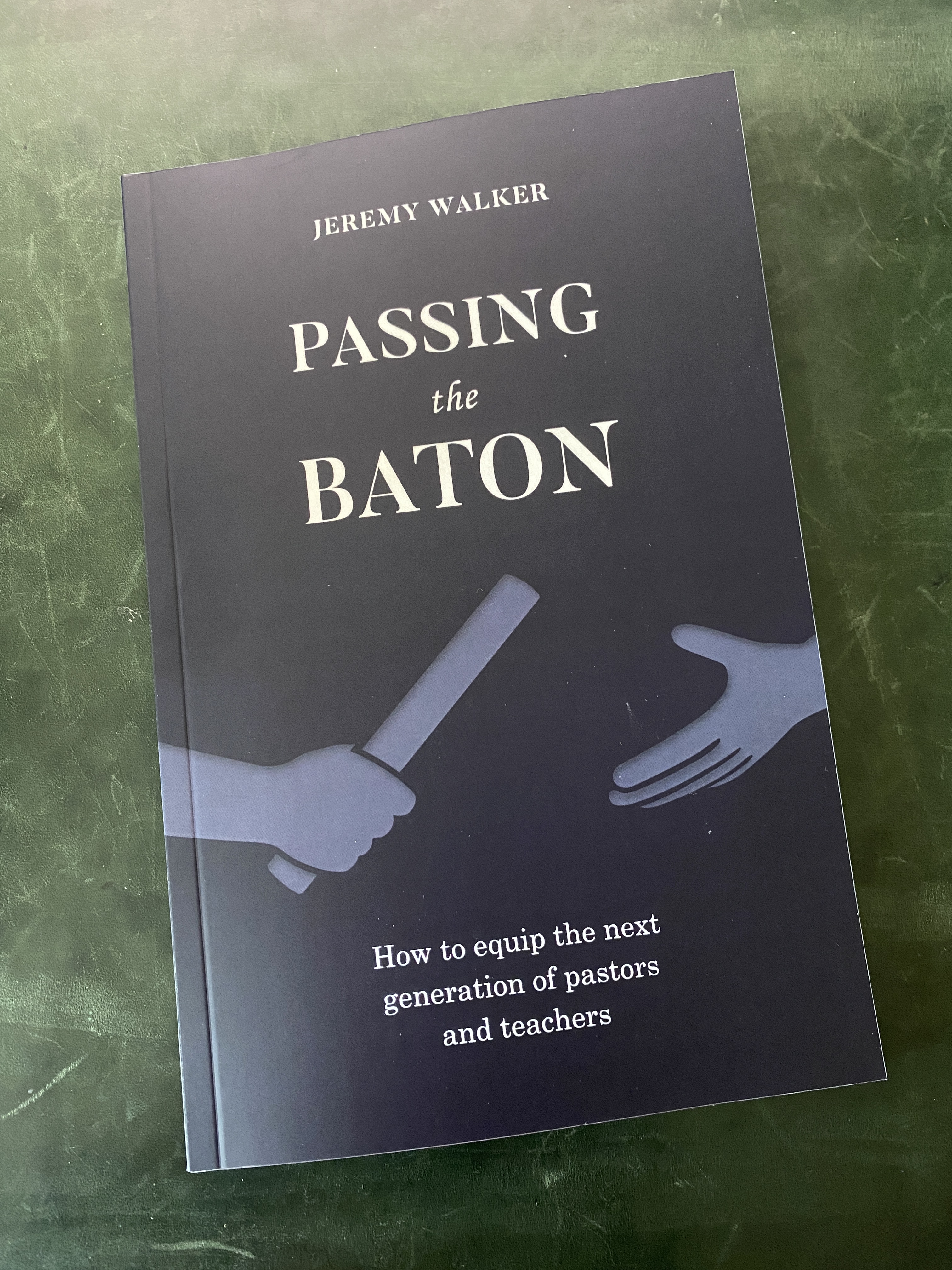
I was glad to get into my hands two new short books, the fruit of more time at home during lockdown. Both are published by Evangelical Press through 10ofthose. One is called Passing the Baton and concerns the responsibility ministers have to train others to follow in their footsteps. The other is called Providing for Pastors, and is about the church’s responsibility to provide adequate financial support for elders.

The worshipper
He is a worshipper. His life revolves around his worship.
Nothing stops him. There is no doubt about his worship. Everyone knows the object of his worship, because he cannot stop talking about it. Even the way he dresses and behaves declares his commitment to his cause. On a Monday morning he is full of the activity of the previous day, recounting everything that took place in the recent worship.
For the whole article, read here.
Coming from God’s presence
The story is an old one, and told of several different men. The details may differ slightly, but the essence is the same. A man is due to preach the Word of God. He is late. Someone is sent to find him. When they come near to where he is, they hear his voice. He is reasoning, pleading, remonstrating with someone. He will not go to preach unless he goes in the company of that person. Sometimes the one overhearing goes back or is sent back again and again, and again does not wish to interrupt; sometimes a door receives a timid knock. Eventually the preacher issues forth with shining face and preaches with the blessing of God. Of course, the longed-for companion was God himself, the presence of the Spirit with the preacher, the favour of Christ upon the ministry, the smile of the Father on his truth.
These stories were brought to mind by reading a comment of Andrew Bonar in his diary, for 6th February 1843: “Have been struck at noticing how often, especially no later than yesterday, in going forth to preach, I was like one seeking his own entrance into the holy place and fellowship with God; not like one coming out from enjoying communion to speak to others.”
What a humbling thought for the preacher! What an enticing one for the hearer! Do we go to preach in the hopes of meeting with God, or do we go to preach because we have met with God? While I think we need to be careful about divorcing those from each other, Bonar’s comment holds. Too often we are still seeking God when we come to the pulpit. Too often we have forgotten that we need not only to find God there, but to go there with God. Like Moses, whose face shone after he had been in the presence of God (Ex 34:29 ff.), we need to come to God’s people as men who who have already known the light of his smile lifted up upon us, and who are then ready and able to speak as those who have been with Jesus.
Let us not, then, dismiss the story of the men who would not go to preach unless they were confident that God was with them. We should not make something artificial of that, for often God is pleased to meet with us as we go. Nevertheless, what heavenly scents and celestial sense might we bring to God’s people if we more often spoke as those who have come out from enjoying communion with the Most High?
Fragile
At least where I am serving, people are fragile. It does not take much to make people cry.
Perhaps it is a small act of carelessness or even cruelty. People are already edgy, if not right on the edge. An unkind word, a thoughtless act, a dismissive interaction, and over the edge we go. The soul is trampled, the spirit is crushed, the heart is cast down. Tears well up quickly, tears of helpless frustration, impotent rage, or simply hopeless distress.
On the other hand, it may be an act of thoughtfulness or kindness. Again, the outer shell is often fragile in these days, and the heart is very close to the surface. There are countless ways in which we can do good to all, especially to the household of faith, in these difficult days. It may be a simple word of encouragement. I have seen people well up just because someone bothered to say thank you to them, or took a moment to ask how they were doing. It may be an act of mercy. I have seen people break down because someone has made them a meal, or dropped off a bag of food, or knocked on the door to check in, or gone back to someone who has served them well with a cup of coffee or hot chocolate. In fact, my children have decided that—unless we make someone cry—we probably haven’t done enough for them.
Under such circumstances, we need to be careful about what might, at other times, seem inconsequential. If we are God’s people, we are living in days when a careless or harsh moment might undo years of patient engagement with those around us, for—rest assured—people often remember the painful sting of a single moment far more clearly than they do the soft wash of long periods of more distant warmth. But, by the same token, perhaps this is a season when, very quickly and easily, a simple but sincere word or deed of kindness might open the door to do some real spiritual good. We follow a Saviour who went about doing good (Acts 10:38), and are ourselves to be zealous for good works (Titus 2:14). Now is a good season to consider this.
Remember, then, that many people are now fragile, even brittle. The heart might lie near the surface, more readily touched than it often is. With what words or deeds will you touch it? Will it be with a dark thorn of unkindness which might quickly and easily do more damage than you had ever imagined? Or will it be with a bright point of kindness and goodness which will prove an opportunity for you to serve not only someone’s body, but even their soul?
Ordinary preaching
It has been a privilege to be part of a church which has supported certain pastor-preachers for as long as I can remember. We are now supporting in retirement (or semi-retirement) men who have served for decades in different parts of the world. They were men of my father’s generation. Several of those men have been God’s instruments in establishing churches which they have overseen directly and planting other congregations. They have seen scores and even hundreds of well-attested converts, and under their instruction men have been raised up to preach and teach in turn, so that in some cases there are already two or three generations of faithful and fruitful indigenous pastors carrying out the work of the ministry.
And, from time to time, it has been our privilege to hear those men in person. They come from places where they preach fluently in a language not their own, sometimes to hundreds of people, to preach in a smaller building to a smaller congregation. It is part of the ongoing relationship of genuine affection and mutual encouragement. We have prayed for these men and given to their work; we have thrilled to reports of God’s blessing on their work. And now we get to hear them preach.
And they are ordinary.
I do not mean in any sense to diminish them or their labours by saying that. If anything, I mean to dignify both. They simply stand up and preach the Word of God. They explain and apply the text. Their substance is biblical. Their language is simple. Their structures are straightforward. Their illustrations are clear. Their humanity is plain. Their earnestness is undoubted.
I think that there are some differences. Friends who have heard them in their own sphere have attested that they are, if anything, more fluent and forceful in their adopted language than in their native tongue, that there is a more evident dynamism in their delivery among their own people. Perhaps they go among people who expect more of God, pray more for their ministers, anticipate a greater blessing with their own faith. (It is, perhaps, the reverse of what some of us have known when we have preached elsewhere, and sermons that fell flat among our own congregations have been owned of the Lord to the conversion or help of many.)
But those preachers themselves, when asked, say, in effect, “No, that’s the sermon I preached the last week I was in my own place,” or, “No, the Lord was pleased to make that series the means of saving many when I preached at home.”
But there is no difference in the truth they preach or the faith they possess. That is an encouragement to ordinary preachers. They simply stand up and preach the Word of God. They explain and apply the text. Their substance is biblical. Their language is simple. Their structures are straightforward. Their illustrations are clear. Their humanity is plain. Their earnestness is undoubted.
No doubt we need to pray more for the blessing of God. No doubt it would help if we preached to eagerly expectant men and women who are anticipating a blessing and praying for one themselves. But there need be no difference in the truth we preach, and there should be no difference in the faith we possess. It is the Word of God, and the blessing is his to give.
The same religion which saved three thousand at Pentecost can save three thousand now. The same preaching which has saved and established hundreds in other parts of God’s world can do the same here, as it has in the past. God’s truth has not changed in its substance nor its power. Our old gospel sword retains a keen edge. The same Spirit attends and can bless the work here and now.
So let me preach my ordinary sermon. Let me seek to do so in the power of the Holy Spirit, by all means, but let me seek nothing more and nothing else. Let me speak God’s truth with sincere faith, and look to God for his blessing.
From the heart of Spurgeon
 Charles Haddon Spurgeon was born in Kelvedon, a village in the county of Essex in the east of England, on 19 June 1834. He went to be with Christ from Mentone, France, on the evening of Sunday 31 January 1892. During his lifetime he became perhaps the greatest preacher in the English-speaking world, of his own or any other century. We marvel not just at the precocious and maturing genius of the man, not just at the sustained numbers of hearers and converts, not just at the faithfulness in the face of much abuse and opposition, not just at the theological clarity amidst growing spiritual confusion, but at the heartfelt and humble holiness of a man who walked with God amidst it all. Spurgeon himself predicted that his reputation would suffer in the short term but that the truth of Christ which he proclaimed would outlast all those slurs: “I do not look so much at what is to happen to-day, for these things relate to eternity. For my part, I am quite willing to be eaten of dogs for the next fifty years; but the more distant future shall vindicate me.”
Spurgeon was the most ardent and articulate exponent and defender of reformed truth in the church of his day, standing firmly against the theological downgrade being experienced by many evangelical churches of his time. He was a preacher, pastor, author, philanthropist … he seemed to roll the work of ten lifetimes into one sustained burst of service to Christ! He probably ranks among the greatest Englishmen of all time, but he claimed that he would not have crossed the road to hear himself preach. We think and know better of him than he did of himself. His sermons and other productions continue to bring blessing to countless souls.
It was therefore with no little interest that I recently responded to the inquiry of a friend who asked how long it would take to read the complete sermons of Charles Haddon Spurgeon at a rate of one a day. “Which ones?” I asked, for in addition to the six volumes of the New Park Street Pulpit (NPSP) and the fifty-seven volumes of the Metropolitan Tabernacle Pulpit (MTP) there are now others available, some dredged out of and collected from The Sword & The Trowel magazine, others a recovery of his earliest sermon manuscripts.
“I’m thinking New Park Street Pulpit and Met Tab Pulpit,” replied my textually-challenged chum.
The answer is that each of those sermons, originally issued as a Penny Pulpit series, is numbered. Beginning with volume one of NPSP, they finish in the combined volume sixty-two and sixty-three of MTP, published for 1916-17, when a paper shortage during the Great War finally put paid to the ongoing publication of Spurgeon’s primary work. There are 3,561 such sermons in total. If you assume consecutive reading, that means nine three hundred and sixty-five day years and two hundred and seventy-six days. If you assume two leap years rather than three, you will finish on day two hundred and seventy-four of the tenth year of reading. If you begin on 1 January, you should finish on 1 October in your tenth year of reading.
Provided with all the necessary information, my semi-literate friend responded thus: “U gonna join me?”
And so was born the scheme for reading Spurgeon. From 1 January 2021, a few intrepid friends will set out to read one of Spurgeon’s sermons each day, beginning with the first volume of NPSP, and continuing on. The first target is to complete the six NPSP volumes, after which we may plough on through MTP. Because this exchange was public, others expressed interest. Being magnanimous types, we decided to spread the joy. A Twitter feed followed, @ReadingSpurgeon, and others began to join in. For those for whom a sermon a day may be a stretch, we hope to recommend one a week. Our friends at Media Gratiae got involved, and now we may be doing a weekly podcast, From the Heart of Spurgeon, and some occasional ‘lively readings’ of select sermons—not acted-out preaching but an attempt to communicate something of the sermonic form and force of those sermons as originally delivered.
Anyone who is interested in either the full or the partial reading scheme is welcome to join us. Just head over to the Twitter feed and follow us for all the necessary information and links. However, there may be others who simply want a taster. With that in mind, here is a brief survey of the Spurgeon material available from The Banner of Truth, an overview suggested by Robert Strivens.
An All-Round Ministry. More or less a mini-pastoral theology, this is a selection of addresses from the annual gathering of Spurgeon’s Pastors’ College. Spurgeon sets out both to instruct and to inflame, so that the work of the ministry is clearly laid out, and encouragements and exhortations for that work supplied. There is a sweet honesty to these addresses, and the closeness between Spurgeon and his students bleeds on to the page.
The Greatest Fight in the World: Spurgeon’s Final Manifesto. This is the final address Spurgeon delivered to those Pastors’ College men. It was delivered in 1891, when Spurgeon was battered and bruised from the Downgrade Controversy (he died 31 January 1892). It is his final call to arms to those who remained faithful, not so much to him, as to their Saviour. He calls the pastor-preacher’s attention to our armoury, the Scriptures, to our army, the church, and to our strength, the Holy Spirit. Reading this will stir your soul, even as it carries you beyond your own strength to rest in that which God supplies.
Flowers From a Puritan’s Garden: Illustrations and Meditations. This is one of those volumes which throws light upon Spurgeon’s distinctive genius. Reading through Manton’s twenty two volumes was not enough. Marking all his striking imagery did not do the job. No, Spurgeon culled them from those pages, arranged them for our delectation, and added some colour of his own! While each of Spurgeon’s deliberations serves as a meditation for us, they also help us to think about how we can turn an illustration into an application, and so adorn our own sermons.
Advice for Seekers. This volume reads like some pastoral chats between a concerned soul and a faithful man of God. Spurgeon did not mistake stirring interest in religion for real conversion, and so was concerned to clear the obstacles that might lie between the soul now alerted to its need and the Christ who meets that need. It is almost conversational in style, and so helpful both to those who still need such counsels and to those who wish to learn how to give them in person. It still serves as a good evangelistic tool, especially to those who already know something of Christianity without knowing Christ himself, and as a good pattern for dealing with souls.
Christ’s Glorious Achievements. One of the things that Spurgeon was good at was selecting and arranging sermons preached more or less separately to create a sort of topical arc. That is what he does here, and Banner have picked up this selection and repackaged it. It shows something of Spurgeon at his best. Of this matter of Christ’s work, he said, “Upon no theme is the true minister so much at home, and yet no subject more completely surpasses his ability. We love the subject, though we are lost in it.” If you are going to get lost in this subject, Spurgeon is a great man with whom to get lost! In seven sermons he takes you on a short tour of Christ’s work, leaving the reader lost in wonder, love and praise.
Majesty in Misery (3 volumes). This excellent and more extensive selection of sermons again carries us to the heart of Spurgeon’s holy obsession with Christ and him crucified. Here the aim is to set before us the very core of our faith, the sufferings and death of our Saviour. The three volumes carry us chronologically from “Dark Gethsemane” by way of the “The Judgment Hall” to “Calvary’s Mournful Mountain.” It is easy to hear Spurgeon’s heart and his voice breaking as he preaches from the page, and the dry-eyed preacher of the present day will learn a true spiritual pathos from Spurgeon’s deeply-felt presentation of our Lord’s physical and spiritual agonies.
C. H. Spurgeon’s Autobiography (2 volumes). This is the condensed version! Spurgeon’s own, completed by his wife and secretary, spans four volumes. I confess to quite liking the full version, but it is very Victorian, and sometimes lacks a little urgency. This is the nuggety edition, keeping the action moving while still giving us plenty to get our teeth into. “The Early Years” carries us into the heart of his London ministry, while “The Full Harvest” depicts the blessings, burdens and battles of his mature years of service. A really wonderful set, up there with Banner’s Whitefield and Lloyd-Jones biographies, though bear in mind that this one has a very different flavour, being autobiographical.
Revival Year Sermons. 1859 was a spiritual jubilee even by Spurgeon’s standards. During this season, Spurgeon preached Christ in the Surrey Gardens Music Hall to a congregation of some 8,000 people. This little selection of sermons from that year of blessing communicates something of the fervour and the earnestness, the directness and the plainness, of Spurgeon’s gospel preaching. The preacher feels that if he could just attain to a tenth of Spurgeon’s spiritual liveliness, he will be a hundred times more than preacher that he now is. His congregation doubtless endorses his feeling! We can, at the very least, learn, and pray, and follow, where we can never copy.
Letters Of Charles Haddon Spurgeon. One of those indefatigable Victorian types, Spurgeon kept up a zesty correspondence, dashing off little notes here and there, as well as longer missives. Iain H. Murray’s selection lets us see Spurgeon the man. We note that there is no gap between Spurgeon at his writing desk and at his pulpit desk: he is manifestly the same person, but here are different glimpses of his humanity and personality, glittering through a variety of letters to a variety of people.
Spurgeon’s Practical Wisdom: Plain Advice for Plain People. There’s a peculiar relentlessness in these pages. It reminds the reader that Spurgeon could probably have been hard work for the less gifted. Writing under cover of the name John Ploughman, these are Spurgeon’s articles on practical topics for the common man—debt, temptation, drunkenness and the like. It is hard to imagine many today responding so warmly to the occasionally patrician tone, but Spurgeon does a good job of ‘talking across’ and not so much ‘talking down.’ This is less gospel exhortation and more moral instruction, and he lays it on thick. Some chapters feel like a couple of hundred sentences all making precisely the same point in a subtly different way. Bearing in mind that these appeared as magazine articles, it helps to read them from time to time, as a repeated dose can become a bit overwhelming.
The Pastor in Prayer: A Collection of the Sunday Morning Prayers of Charles Spurgeon. This man of God prayed like a child. There is a simplicity of vocabulary and a directness of address here that puts even the sermons to shame. One gets the sense of what it means to speak to God on behalf of men. In a spirit of humble dependence, Spurgeon approaches our Father in heaven; in a spirit of expectant faith, he lays before a gracious God the needs of the hour; in a spirit of eager hope, he leaves the throne of grace equipped and energised for the labour at hand. Reading these, one wonders whether a Christian might not have gone to the Tabernacle to hear Spurgeon pray as much as to hear him preach.
Metropolitan Tabernacle (Volume 38: Sermons Preached and Revised in 1892). Somewhere on a shelf I have a collection of Banner’s battered yellow-jacketed volumes of the Metropolitan Tabernacle Pulpit series, of which this seems to be the last published survivor. First issued by Passmore & Alabaster right at the end of Spurgeon’s life and ministry, this is the man of God at the coalface, to his last days making known the glorious gospel of our Lord and Saviour Jesus Christ. Compared with his earliest pulpit efforts, there are some clear differences in aspects of tone and approach, marking the very different circumstances, but not in real substance. Still it is Christ, preached from the whole of Scripture, which attracts and holds the heart of the preacher, and still it is Christ, in all his saving majesty, who is held out to all who will hear.
Lectures to My Students. While many editions of this work abound, this is a beauty! Fully reset, and with all the paraphernalia which Spurgeon put in the original, it rocks with humanity and humour. Here is Spurgeon putting the point on the pin, putting the edge on the blade forged during his students’ week in the college. Deliberately lively to aid the flagging spirits of those weary men on a Friday afternoon, this is still a tonic for the soul. We forgive readily every occasion on which Spurgeon forgets that the rest of us are not him, and wonder at the kind of men who such instruction must have produced. Spurgeon pulls no punches, dilutes no truth, softens no blows, and relieves no duties, but neither does he withhold any sympathies, reserve any encouragements, or dash any hopes. Still a wonderfully positive but enduringly realistic take on the work of the ministry, it covers some topics that others barely touch. It perhaps focuses more on the pulpit than the parlour (as Spurgeon might have said)—more on the preaching ministry than the personal pastoral dimension. This edition includes Spurgeon’s bewilderingly brilliant “Commenting and Commentaries”; when you read Spurgeon’s commendation of a particular volume, this is often where it comes from.
Commentary on Matthew: The Gospel of the Kingdom. Let me recast a previous brief review: this is the only complete commentary on a book Spurgeon wrote (excepting his treatment of the Psalms, which was in some senses more of a compendium of others’ comments). It is magnificently Spurgeonic: from its opening paragraph, Spurgeon points us to Christ and never once loses sight of him in all the pages that follow. With laudable brevity, wry wit, proverbial pithiness, earnest devotion, vigorous plainness and gripping earthiness, Spurgeon paints his portrait of the King of kings, bringing the beauties of the Lord Christ into sharp relief and sweet expression. Other commentaries may provide an anatomically correct model of this Gospel, but Spurgeon gives you its beating heart.
A Defence of Calvinism. A little booklet in which Spurgeon extols the free grace of God in the salvation of lost sinners. Again, his direct mode of address grips us, as Spurgeon speaks directly off the page to his reader. This is less aggressive than you might imagine, but there are no concessions with regard to truth even while he embraces brothers who differ from him on the points he raises. On the one hand, one might feel that Spurgeon was perpetually in Calvinism’s so-called ‘cage stage.’ On the other, he is so forthright, so amenable, so open, that he comes across well even at his most in-your-face. This is a good, personal, warm, and engaging treatment of several of the issues that are often raised as one begins to understand that gospel of free grace which often goes by the nickname of Calvinism.
Zwingli’s plague hymn
What follows is a hymn written by the Swiss Reformer, Ulrich Zwingli (1 January 1484 – 11 October 1531) during a seminal period in his life when he was afflicted with the plague. It is grounded in the language of Psalm 18:2: “The LORD is my rock, my fortress and my deliverer; my God is my rock, in whom I take refuge, my shield and the horn of my salvation, my stronghold.” The whole is divided into three sections, one referring to the onset of the disease, the next to the lowest point, and the last to the joy of recovery, with determination to walk in faith and with holiness from that point on.
Sickness
Help me, O Lord,
My strength and rock;
Lo, at the door
I hear death’s knock.
Uplift thine arm,
Once pierced for me,
That conquered death.
And set me free.
Yet, if thy voice,
In life’s midday.
Recalls my soul,
Then I obey.
In faith and hope
Earth I resign.
Secure of heaven.
For I am thine.
Decline
My pains increase;
Haste to console;
For fear and woe
Seize flesh and soul.
Death is at hand.
My senses fail.
My tongue is dumb;
Now, Christ, prevail.
Lo! Satan strains
To snatch his prey;
I feel his grasp;
Must I give way?
He harms me not,
I fear no loss,
For here I lie
Beneath thy cross.
Recovery
My God! My Lord!
Healed by thy hand.
Upon the earth
Once more I stand.
Let sin no more
Rule over me;
My mouth shall sing
Alone to thee.
Though now delayed,
My hour will come.
Involved, perchance.
In deeper gloom.
But, let it come;
With joy I’ll rise,
And bear my yoke
Straight to the skies.
Review: “Gentle and Lowly: The Heart of Christ for Sinners and Sufferers”
Gentle and Lowly: The Heart of Christ for Sinners and Sufferers
Dane C. Ortlund
Crossway, 2020
224pp., hardback, $19.99
ISBN 978-1-4335-6613-4
Some assured me that it was the greatest book they had read in years. Others warned me that it was profoundly dangerous. Reviewers have largely fallen over themselves to commend it. It is a topic which I need to grasp personally and pastorally. So I took it up and read it. The book is from Dane Ortlund, is called Gentle and Lowly, and is—more or less—an attempt to rework Goodwin on the heart of Christ (available as a Puritan Paperback from the Banner of Truth) for a modern audience, with primary assistance from Sibbes, Owen, Flavel, and Bunyan, and occasional contributions from Edwards, Warfield, and one or two others.

In style, it is interesting, at times combining Blairite sentence fragments with complex and lengthy sentences that would make a Puritan blush. It is generally accessible, but some of those heavier sentences are like steamrollers. I wonder if people are so persuaded that the seventeenth-century authors are unreadable that they never bother finding out if they are at least as clear as some of our more modern writers? That is true, not just of Ortlund’s style, but also in his substance.
So what of the substance? ‘This book,’ says the author, ‘is written for the discouraged, the frustrated, the weary, the disenchanted, the cynical, the empty.’ Its message is ‘that we tend to project our natural expectations about who God is onto [sic] him instead of fighting to let the Bible surprise us into what God himself says’ (13, 155). If the message so stated seems to fall a little short of the target audience, then we need to dig a little deeper.
Ortlund is addressing a genuine and proper pastoral concern, and one which may well be more pressing in his circles than in those of some readers. Most pastors will recognise the malady when he writes that ‘many of us tend to believe [that God’s love in Christ] is a love infected with disappointment’ (189). Ministers wrestle with men and women, believers and otherwise, persuaded that they are utterly unloveable and entirely beyond love. In part, like Ortlund, I am persuaded that this probably reflects a failure properly to appreciate and appropriate the incomparable depths of God’s love toward us in Christ Jesus, and—perhaps, therefore—further reflects a fear of preaching the heart of Christ in all its fulness of love. After all, what if people got the wrong impression and thought that they could sin and get away with it? But, on the other hand, what if people concluded that, because they had sinned, they were helplessly and hopelessly done for, because Christ would quickly become frustrated with us and leave us to our own wretched devices? It may be that Ortlund is conscious of an excessive intellectualism in his own circles, a technical grasp of what Christ is and does without an experimental acquaintance with our Lord’s heart toward us that spills over in our lives and from our lips. Whatever the case, he is quite right to quote Jeremiah 31:20 about the yearning of God’s heart, and challenge us, ‘Does your doctrine of God have room for him speaking like that?’ (164).
In the course of the book there are moments of penetrating insight into the Scriptures (such as the developed parallel between God’s self-revelation to Moses on the mountain and the actions of our Lord Jesus with his disciples), or points at which his apposite quotation of the Puritans, or communication of their sense, leaves the heart singing.
The book as a whole consists of twenty-three reasonably brief chapters, with an introduction and an epilogue. It concentrates more on the character of Christ, although his nature as the God-man is used to elaborate on the depths and demonstrations of his heart toward us. While the first chapter picks up the language of Matthew 11:29, which supplies the title, every chapter takes a verse, or more often a phrase, as its point of departure. The author wants us to understand the depths of Christ’s sympathy for and with sinners, his readiness to receive the penitent wanderer returning home, his patience and gentleness with his erring people, his intercession and advocacy for us in his glory, his perfect emotions in his dealings with us, his persevering affection, and the way in which his heart beats in time with the Father and the Spirit, revealing the Father’s heart and exemplified in the Spirit’s presence and operations. Ortlund labours constantly to overcome our sinful suspicions of the Lord, the twisted pride that assumes we are actually too bad to be saved, or the fear that we have messed up and have put ourselves if not beyond the power then perhaps beyond the patience of a loving Saviour. Some chapters rely more heavily on his source material. Goodwin ties the whole together, but specific chapters owe more or less to other authors, and one or two—such as the chapter on the emotional life of our Lord—are largely summaries of longer pieces by older authors.
As a whole, the theme is wonderfully sweet and absolutely vital. Ortlund’s emphases are sadly missing in too many churches. (It is worth remembering that not everything that he sees as missing has been or is being missed in every church and by every preacher.) For many a battered and bruised soul, either wondering if God could ever love them or keep loving them, there is much truth here to instruct and to comfort, truth presented with a necessarily emphatic edge. Sinners coming to Christ for the first time need not only to be persuaded of their own emptiness and weakness, but also persuaded that the Redeemer is not only absolutely able but eminently willing to save them—he delights to glorify God in receiving the most wretched of sinners. Further, saints need to enter ever more fully into the depths of Christ’s love, never despairing of him and therefore over themselves, but confident (without carelessness) that this fountain opened for sin and for uncleanness will ever be accessible to them, that their Lord and Saviour is more willing to forgive their sins than they might be to come to him for forgiveness. It is a truth that is intended to draw us to Christ and keep us near Christ, and should we ever drift away from him, to bring us back, more fully persuaded of his abounding and enduring love.
So persuaded am I of the need for more such preaching and teaching that I am borderline desperate to be able to commend this book without reservation as a remedy for some of the spiritual ills that afflict far too many doctrinally-sound but experientially-shrivelled Christians and congregations.
I cannot do that. I cannot commend it without reservation, despite my appreciation of the overarching thrust and intent, because I have three particular areas of significant concern. The first has to do with the overstatements that unbalance the book, including some false absolutes and false dichotomies; the second has to do with what seem to be certain subtle misrepresentations or reworkings of the Puritans and their emphases; the third has to do with a lack of clarity in theology proper and Christology.
With regard to overstatement, I mean a tendency—all too frequent both in books and pulpits—to make a point by absolutising one’s statement, or by seeking to throw truth into sharpest relief by setting it in contrast to other statements. This is proper when the other statements are false, but when it leads to the presentation of false absolutes or false dichotomies it undoes itself. I fundamentally agree with Dr Ortlund when he asserts that ‘it is impossible for the affectionate heart of Christ to be overcelebrated, made too much of, exaggerated’ (29, original emphasis). That does not in itself remove the danger of subtly misrepresenting Christ and his heart, even with the best of intentions. I am not sufficiently familiar with Dr Ortlund’s writings to know whether or not other books or articles offer further perspectives that together provide a more complete and balanced presentation of the points he makes here. Neither am I demanding a constant stream of deadening nuance, in which every writer or preacher must identify the seventeen things he does not mean before he says what he does. If we deal every absolute statement the death of a thousand qualifying cuts we are likely to undo our usefulness. That does not, though, suspend the duty for careful precision in the statements themselves. I would not try to cripple any communicator of truth, but we are most free when truly precise, working within the carefully-defined limits of our whole theology and the analogy of Scripture. There are moments at which I think Dr Ortlund either goes beyond himself in his understandable enthusiasm, or fails to be as careful as he might need to be when dealing with some details. Virtuosity is still jarring when in the wrong key.
Lest I seem to tilt at windmills, let me offer a concrete example from the opening lines of Chapter 20: “There are two ways to live the Christian life. You can live it either for the heart of Christ or from the heart of Christ. You can live for the smile of God or from it. For a new identity as a son or daughter of God or from it. For your union with Christ or from it.” On the surface it reads well, and sounds deeply ‘spiritual.’ But put those phrases in parallel and there are some category confusions: are the heart of Christ, the smile of God, a new identity, and union with Christ all precisely identical under all circumstances? What do the prepositions ‘for’ and ‘from’ mean in connection with those particular phrases? Does it make any difference if you are already a believer or not? Ortlund makes clear he is talking about the Christian life. So, for example, if you had asked the apostle Paul whether or not he first obtains union with Christ and a new life by his own efforts, he would have denied it from his soul. However, had you asked Paul if, as a Christian, he lived for the smile of God or from it, he would cheerfully have answered, “Yes!” (based on 2 Corinthians 5:9–11, Galatians 2:17–21, and Philippians 3:7–14, to take three prominent examples). Paul might also have insisted, using careful language, that—having begun in the Spirit, but not now being made perfect by the flesh (Gal 3:3)—we nevertheless go on demonstrating our union with Christ and enjoying the smile of our heavenly Father by way of a life of principled obedience.
On another occasion, in order to make a point, Ortlund insists that “justification is largely a doctrine about what Christ has done in the past, rooted centrally in his death and resurrection” (78), quoting the first half of Romans 5:1, emphasising thus: “we have been justified” (ESV). However, the whole verse reads tells us that since we have been justified by faith, we have a thoroughly present and enduring peace with God as justified men and women, through our Lord Jesus Christ. Ortlund’s characterisation of justification allows him then to insist that ‘intercession is the constant hitting “refresh” of our justification in the court of heaven’ (80). It is not that all this is entirely wrong; it is, though, unbalanced or incomplete in its presentation. Such overstatements can become unhelpful. Should we insist that ‘the Christian life is simply the process of bringing my sense of self … into alignment with the more fundamental truth’ of how Christ feels about us (187)? If I make that my working definition of the Christian life I think I am likely to leave people confused and misdirected.
This isolation of justification comes out in another curious way, and in another direction. Anyone who reads the mainstream Puritans will appreciate their emphasis on the application of truth to the heart. There is distinction but no distance, let alone divorce, between the elements of their soteriology. But, in his epilogue, Ortlund hammers home that his book is about the heart of Christ and of God, and then asks and answers the question, ‘But what are we to do with this? The main answer is, nothing.’ According to Ortlund, to ask, ‘Now how do I apply this to my life?’ would be ‘a trivialization of the point of this study. If an Eskimo wins a vacation to a sunny place, he doesn’t arrive in his hotel room, step out onto the balcony, and wonder how to apply that to his life. He just enjoys it. He just basks.’ The only thing we need to do is go to Jesus, and ‘all that means is, open yourself up to him. Let him love you. The Christian life boils down to two steps: 1. Go to Jesus. 2. See #1.’ All of this is supported with a quotation from Goodwin that, slightly disingenuously, does not actually come from the book, The Heart of Christ. What Ortlund does not say is that Goodwin actually finishes his work on Christ’s heart with four uses (the Puritan language of application). I acknowledge that this is slightly shoddy from Goodwin; if he were on form, we might expect a good forty or so! Also, taking into account the applications and exhortations sown by Goodwin throughout the whole, let us note that it is not just unlike the Puritans, but unlike Goodwin himself, to suggest that our only response is to bask in this truth. Goodwin, in keeping with the emphasis of the best of Puritanism, includes stirring exhortations alongside sweet encouragements. His third use is that, ‘As the doctrine delivered is a comfort, so the greatest motive against sin and persuasive unto obedience, to consider that Christ’s heart, if it be not afflicted with—and how far it may suffer with us we know not—yet for certain hath less joy in us, as we are more or less sinful, or obedient’ (Goodwin, 4:150). At this point you might appreciate why Ortlund sometimes paraphrases Goodwin, so let me do the same. Goodwin is simply pressing home the fact that Christ grieves over our sin and rejoices over our obedience, and that should make a difference to our pursuit of godliness. ‘Take this,’ says Goodwin, ‘as one incentive to obedience, that if he retained the same heart and mind for mercy towards you which he had here on earth, then to answer his love, endeavour you to have the same heart towards him on earth which you hope to have in heaven.’ The proper response to Christ’s heart is not simply basking in his love, but also responding to it with a love of our own that manifests itself in cheerful obedience.
Sometimes, Ortlund simply needs to be more careful with his language. For example, he asks, ‘Do you know what Jesus does with those who squander his mercy? He pours out more mercy. God is rich in mercy. That’s the whole point’ (179). One understands what he is trying to say, but there will be many on the day of judgment who are cast into the Pit precisely because they have squandered (recklessly wasted and cast away) the real and offered mercies of the Lord Jesus. Such imprecision opens the door to potentially dangerous misunderstandings.
Such examples could be repeated several times over. Many such sweeping statements sound clever and are catchy. Digging deeper, though, one finds that they are not properly compelling, and some effectively downplay other necessary or complementary emphases. All this is fine when we are carried along on the wave, less satisfying should we be only temporarily lifted up by the froth. While we do want people to grasp the heart of Christ for sinners and sufferers, that must be a well-grounded and accurate grasp. Overstatement for effect will ultimately hinder or even cripple our efforts to communicate the truth.
This concern bleeds, second, into the way in which Ortlund handles and riffs off the Puritans and others. To be fair, his selection of their quotations is typically judicious, and there are several moments at which one reads a few lines from Goodwin or Bunyan and wants to shout, ‘Nailed it!’ When our author gets it right, he often gets it delightfully right (aspects of his treatment of Warfield on the emotional life of our Lord, for example). However, as we have said, he is making a selection, and selection is often, by definition, interpretation. Sometimes Ortlund takes it upon himself to explain or develop what these other authors have said. In doing so, he seems sometimes to leave out important elements, or to go beyond his sources, or to rephrase them to say something slightly more, less or different. What you have here is essentially Goodwin mediated by Ortlund, not unlike the way in which many read Edwards as mediated by Piper. There is a selective emphasis that necessarily reflects the convictions and priorities of the mediator, and may—inadvertently or otherwise—skew the force of the original to some extent. As so often, it is important to listen to what is not being said, as well as the things that are being said. See, for example, the comments above about the way in which Goodwin applies these truths to God’s people, which is largely missing from Ortlund’s treatment.
Some of this is a matter of vocabulary. Ortlund tends to default to the language of love for the disposition of Christ toward us. It becomes a catch-all cognate for the disposition and all the affections of Christ as they are manifested towards us. While that is sometimes equally true of the Puritans he quotes, they are typically a little more precise. For example, even in the quotations he selects, the Puritans upon whom he relies often use the notions of pity or mercy not as simple synonyms for love, but as functions of love, love responding in certain ways to certain situations. Would it be better, rather than simply to say that Christ loves us all the more, the more we sin, to say that—because of the great love with which he loves us—our sin only draws out the more pity and mercy from his loving heart? Ortlund often hits that sweet spot, as when he assures us that ‘as [God’s] love rises, mercy descends. Great love fills his heart; rich mercy flows out of his heart’ (174). On other occasions, one wonders if a more careful definition of love and its manifestations might have been helpful, rather than assuming that we all instinctively grasp what love is and ought to be, and how it ought to act.
This leaves us sometimes reading Ortlund’s elucidation of Puritan teaching and finding it less clear or crisp than the Puritans themselves. At one or two points he lacks the happy ruthlessness of Puritan logic or precision of language, and, on occasion, the consistent and comprehensive grasp of truth that keeps them from going too far or not far enough in making a certain point. To be fair, there are times when Goodwin and company make assertions that take the breath away, and leave you feeling as if you are teetering on the edge of heresy, so bold are their declarations of the readiness of Christ to receive and go on receiving sinners. However, I do not recall reading the men and works that Ortlund quotes with quite so many questions or niggles. Again, I am not pushing for endless qualification (if that were so, this book would be three times as long as the weightiest Puritan tome!), but for precision and carefulness in the foundational statements. Perhaps I am just more conscious of the issues of the modern day, better attuned to the current issues and the way they are framed, but I don’t recall raising these issues with Goodwin, Owen, Sibbes, or Bunyan. These men seemed better able to address the ‘yes, buts’ or pre-empt the ‘what ifs’ of their magisterial declarations. Some of that breadth and balance is missing in Ortlund’s recapitulation of Goodwin.
Finally, there is the concern of his theology proper and his Christology. I do not envy Ortlund here, and I am deeply conscious that I am picking holes in a game effort to accomplish something at which I constantly fail. He is sailing deep waters, and makes a good fist of seeking to take account of the fact that he cannot deal with the incarnate Son without addressing the persons of the Father and the Spirit, and that the incarnate Son himself is indeed the God-man, two distinct natures in one person forever. I applaud the preacher or writer who manages a lifetime of addressing such things without a moment’s deviation or confusion!
Ortlund is himself deeply aware of that danger. He reminds us that J. I. Packer ‘once wrote that “a half-truth masquerading as the whole truth becomes a complete untruth.” This is an especially sensitive point when we are talking about the Bible’s revelation of Christ’ (28). Shortly after, he warns that ‘we should beware a one-dimensional portrait of Christ that elevates one [dimension] to the neglect of others’ (35). Awareness of the trap does not prevent one slipping into it, if not quite becoming entirely caught up in it. Again, some of this may be a function of Ortlund’s enthusiasm, his working assumption that some things cannot be over-exaggerated. He is also trying to push back at some common misconceptions, such as the sense of some believers that ‘the Son of God came down from heaven in incarnate form, spent three decades or so as a human, and then returned to heaven to revert back to his preincarnate state’ (103). To be fair, across the book there are attempts to ensure that a properly scriptural balance is maintained, but balance is not necessarily the same as correctness and correction.
As the book’s own title makes plain, the focus is on the heart of Christ. There are, then, particular dangers in setting, or seeming to set, the heart of the person of the Son apart from the other persons of the Godhead, and so potentially disrupting the Trinity, or the heart of Christ-as-God apart from the heart of Christ-as-man, and so potentially disrupting the person of Messiah. There are challenges both in positively presenting all that, and in preventing or countering potential confusion about it.
For some, the difficulty might lie in the fact that Ortlund appears to go quite readily down Rob Lister’s route on anthropopathism (God’s ascription of human affection or emotion to himself as a way of accommodating himself to our understanding in making himself known). Ortlund seems quite dismissive of any attempt to discern between emotions or affections in our speaking of God, and perhaps feels that this book is not the proper place to explore fully the ways in which the God-man has sinless human emotions as well as divine affections (his chapter on Warfield is good in this respect). Again, the book is not a contribution to recent debates on divine impassibility (which Ortlund refers to, in connection with Lister as a helpful resource to ‘explore the way God is both impassible and yet capable of emotion’, in a substantial footnote on page 73). However, it is obviously not an issue that can be side-stepped when dealing with the heart of our Lord. Ortlund takes pains later in the book to make clear that Christ’s heart is not apart from the Father’s, still less against it, in his disposition toward us; this can feel more of a balancing act than a correction. We are still left with a danger at earlier points of not so much dividing as isolating the heart of Christ from the heart of the Father. Confusion on impassibility may lie behind statements such as the assertion that God ‘is—if I can put it this way without questioning his divine perfections—conflicted within himself when he sends affliction into our lives’ (138). Is that the safest way of putting it? Does that qualification keep us clear about whether or not the God of all the earth can be self-conflicted?
Again, Ortlund himself warns against the danger of being carried too far in seeking to go far enough. No preacher would begrudge him a proper enthusiasm, but not at the price of necessary precision. In an attempt to show us something great in Christ, there is that constant danger of presenting a one-dimensional Christ. I am not sure that he always stayed on the right side of that line. There are nuances and qualifications, for example, about Christ’s holy hatred of sin, but perhaps not sufficient, or sufficiently clear, to keep some from concluding that we are free to squander present mercies with the confidence that more mercies will come. In Sinclair Ferguson’s language, we need to preach a whole Christ. We cannot always (ever!) say everything, but we might need to say enough, in context or over time, manifestly to keep from preaching less or other than a whole Christ.
Anyone who raise such concerns needs to be aware of at least two dangers for themselves. The first is that, in attempting to keep from error, we will not state the whole truth with the fulness and freeness of the Scriptures themselves. So fearful might we be of legalism that we become antinomians, so fearful of antinomianism that we become legalists, or seek to counter the one with a dash of the other. In the same vein, men constantly on the lookout for even the most minute error in speaking of divine affections might find themselves unable or even unwilling to give free rein to Scriptural language or proper vent to their own souls in seeking to communicate the sweet wonders of the heart of God in Christ toward his beloved people. We cannot afford to be ashamed of or to draw back from biblical truth presented in biblical language.
To conclude, and without wishing to overstate it myself, I am persuaded that this theme is often and tragically overlooked or undercooked. For whatever reasons, the heart of Christ is too often clouded to us and by us. Lost sinners need to be confident that a saving Christ will receive them with infinite readiness and tenderness. Christians need to know Christ’s disposition of love toward us, and to feel it, and to understand the ways in which it is manifested toward us. Because of my delight in the topic, I wanted to love this book, and at points I did. Nevertheless, I too often felt I needed subtly, internally, to rework a phrase, to introduce a nuance, to press further a point, or to adjust an assertion. I still think that for some whose spiritual diet has been lacking this emphasis, Gentle and Lowly could be like a cup of cold water to the soul. For some who preach a known Christ competently, this book might help to preach a felt one earnestly. We need all that is true in this book. Even so, I think there is a danger that it might not so much correct certain imbalances as introduce different ones. I understand why some recommended it with almost no reserve, while some were so reserved they felt that they could not recommend it. That might depend on their circumstances and the people to whom they minister. I am quite confident that, if I preached Christ in all his fulness, I might eventually be accused both of antinomianism and legalism, depending on which truth I happen to be emphasising. That is why a bit more Puritan precision without any loss of Puritan passion (emotion? affection?) would be welcome. That carefulness needs to become second nature to the theologian, so that our language more instinctively, regularly and carefully reflects the whole truth of the whole Christ. I write all this not to be wilfully contrarian, or simply pernickety, but because I think that there are not so much flaws in the diamond itself, but rather genuine concerns about its presentation.
Much good will have been done if this book drives us back to the Puritans. In many modern editions, the Puritans are at least as accessible as this book, or become so for those willing to put in a little effort. Those Puritans also tend to be, I think, more complete and careful. For many, one of the better responses to this book will be to read Goodwin for themselves. However, more will have been done if Gentle and Lowly, with the men upon whose shoulders it stands, drive us back to our Bibles to search out and see these things in Christ for ourselves. If nothing else, it should remind us of the need to grasp these truths in our souls, and to tell them to others, even if we believe that we could and should tell them better. The great tragedy would be to conclude that we have nothing to learn in this matter. If so, it might either be because we have advanced beyond many of our contemporaries in our exceeding zeal for the honour of Christ and the good of his people, or—more likely—because we have not grasped the greatness of this theme, the glory of God revealed in it, or the good that comes to God’s people from a firmer grasp on the loving heart of the Altogether Lovely One.
Wesley shoots
Plain counsel from John Wesley to a fellow-preacher:
What has exceedingly hurt you in time past, nay, and I fear, to this day, is, want of reading. I scarce ever knew a Preacher read so little. And perhaps, by neglecting it, you have lost the taste for it. Hence your talent in preaching does not increase. It is just the same as it was seven years ago. It is lively, but not deep; there is little variety; there is no compass of thought. Reading only can supply this, with meditation and daily prayer. You wrong yourself greatly by omitting this. You can never be a deep Preacher without it, any more than a thorough Christian. O begin ! Fix some part of every day for private exercises. You may acquire the taste which you have not: What is tedious at first, will afterwards be pleasant. Whether you like it or no, read and pray daily. It is for your life; there is no other way; else you will be a trifler all your days, and a pretty, superficial Preacher. Do justice to your own soul; give it time and means to grow. Do not starve yourself any longer. Take up your cross and be a Christian altogether. Then will all the children of God rejoice (not grieve) over you; and, in particular, [me].
“My day is drawing to an end”
Written after spending time talking with a saint who is nearly home.
UPDATE: I wrote this after making my visit on Tuesday 30 June 2020. It reflects some of what we spoke about, but I never read these words to her. The lady with whom I spoke went to be with Christ on the evening of Wednesday 01 July 2020. It makes these truths all the sweeter. She knows most of this now by experience, and is awaiting the dawn.
Belmont C.M.
My day is drawing to an end,
The light of life grows dim;
My thoughts to Christ all sweetly tend,
For soon I’ll be with him.
I must put off this feeble tent,
But death itself defy;
My soul released, I’ll make ascent
To be with Christ on high.
The sufferings of this present time
Soon swallowed up in love;
Out of this pain and darkness climb—
Glory to come above!
My soul with him in perfect joy
Will wait the coming morn;
I know that nothing can destroy
The hope of that new dawn.
In Christ most happy and most blessed,
A body new I’ll take;
And all be peace, delight and rest
When in his form I wake.
And much that I have known below
Shall quickly fade away,
But life in Christ I’ll ever know,
In God’s eternal day.
©JRW

See all hymns and psalms.
The restoration of public worship (again)
Having heard nothing yet from the Rt Hon Robert Jenrick MP, Secretary of State for Housing, Communities and Local Government, about the prospects of Christian churches meeting for worship as soon as possible, and given recent developments, I have written again. And, again, I put it here not as the last word, but in the hopes that others might also be able to make representations along these lines for a recognition of our duty and our right to gather responsibly for the worship of the true and living God.
Further to my previous letter of Wednesday 27 May, I would like to raise once more the issue of the worship of Christian churches of the kind to which I belong.
As previously stated, in the matter of Christian worship, the focus in the Bible is on the people who worship rather than the place of worship. While I am sure that many are glad that places of worship are now open for private prayer, for Christians who value the gathering of the church for corporate worship (that is, our worship as a gathered body of believers) it offers little help. We can and do pray at all times and in all places. As made clear in my previous letter, for the Christians for whom I speak, nothing can replicate or replace the distinct spiritual privileges of meeting together for worship as a church, according to the direction of the Bible and therefore our religious principles. Such gatherings encourage and express our deepest convictions and hopes as believers in Jesus Christ.
Recently, the Prime Minister tweeted this: “People have a right to protest peacefully & while observing social distancing but they have no right to attack the police. These demonstrations have been subverted by thuggery – and they are a betrayal of the cause they purport to serve. Those responsible will be held to account” (@BorisJohnson, 9:13pm, 07 Jun 2020). Would the Prime Minister, and you, also be willing to assure us that people have a right to worship God peacefully while observing social distancing and not attacking the police? We believe we can and should be able to gather for worship outside of our church buildings, and to do so at least as responsibly, carefully and safely as any comparable activities.
In that connection, we are aware of moves toward the reopening of cafés, pubs and restaurants, perhaps allowing responsible service outside while maintaining social distancing. If this is the case, whether in June or July, then it should be possible for Christians to meet for worship outside their existing church buildings. My previous letter outlined some ways in which we might be able to do this responsibly, carefully and safely. Given the nature of our regular gatherings, especially with social distancing measures observed, the impact on the R number of meeting in this way for worship would, at worst, be minimal.
I appreciate that there are countless calls on your time and energy at present, and we do pray for God’s favour toward our country and those whom he has put in government over the nation. I look forward to hearing from you, and to positive suggestions as to how the church which I serve, and others like us, can honour God in our obedience to him, while also honouring the civil authorities which God has established.
The restoration of public worship
Encouraged by efforts in other places, I have written to the Rt Hon Robert Jenrick MP, Secretary of State for Housing, Communities and Local Government, about the prospects of Christian churches meeting again as soon as possible. The letter has been copied to Baron Greenhalgh, Faith Minister, and my local Member of Parliament. I put it here not because I think it is the last word, but in the hopes that others might themselves be encouraged to do more, better.
I hope that this communication finds you, and yours, safe and well during these still difficult days. My name is Jeremy Walker, and I am a pastor of Maidenbower Baptist Church in Crawley, West Sussex. I am writing about the government’s plans for the restoration of public worship in Christian churches.
As the government attempts to lead us out of lockdown, I am conscious of the difficult decisions and fine judgments that government and Parliament make and carry out, and the wisdom required. The church of Christ makes this a matter of particular prayer. We pray not as an issue of party political allegiance (1 Timothy 2:1–2) but because the church is a spiritual body rather than a political or even a social agency.
In this regard, I and others like me have been disappointed and even distressed to see the government’s plans for the restoration of public worship. At present, church buildings are in Step Three of the government’s plan (OUR PLAN TO REBUILD: The UK Government’s COVID-19 recovery strategy), in which the ambition “is to open at least some of the remaining businesses and premises that have been required to close, including personal care (such as hairdressers and beauty salons), hospitality (such as food service providers, pubs and accommodation), public places (such as places of worship) and leisure facilities (like cinemas)” (page 31).
When it comes to the matter of religious worship, the focus in the Bible is on the people who worship. The focus in government policy appears to be on the place of worship. When the focus is on the latter, the physical space and social dynamics of a church building lead to it being classified among other enclosed social spaces like cinemas, theatres and restaurants. When the focus is on the former, the question becomes one of facilitating our corporate gathering as what the Bible calls “the body of Christ”—the people who are joined to him by our faith in him, and who thus become the spiritual family of God.
I note that the Ministry of Housing, Communities & Local Government has established a taskforce developing a plan to reopen places of worship. However, it seems that Christians who share my convictions about our faith and life (Protestant and Dissenting) are substantially absent from that taskforce. For the Christians of whom I am representative, both in Crawley and elsewhere, it is the act of worship more than the place of worship that is important. So, for example, the government suggests that places of worship may be open for private prayer before Saturday 4th July. While we commend any move toward the safe opening of our church buildings, we can privately pray anywhere and at any time, and we do, together with other acts of private and family devotion.
However, for the Christians for whom I speak, nothing can replicate or replace the distinct privileges of meeting together as a church under the Word of God preached to us in person. Christians like me join believers in other nations in making clear that neither confessional Christian faith nor the church as a body can faithfully exist without a Lord’s day gathering. As others have said in other countries, the Bible and centuries of habit oblige Christians to gather weekly for worship and witness around the Word of God and sacraments—we need one another to flourish in our service to Christ (Exodus 20:9-11; 1 Corinthians 16:1-2; Hebrews 10:24-25; Acts 2:42, 20:7). This divine obligation and hard-won historic freedom supersedes all human legislation and regulation. The church is not comparable to any other social venue and cannot be dismissed as non-essential by an expert in any field. We say with respect that the church does not exist and is not regulated by permission of the state, for its establishment and rule is found in Jesus Christ himself.
The biblical rhythm of worship is weekly, gathering on the first day of the week to honour God and to receive spiritual blessings from him as his Word is preached. It is why the Bible commands us not to forsake the assembling of ourselves together (Hebrews 10:25). The language of weekly corporate gathering is used repeatedly in the New Testament, and to it are attached any number of divine encouragements to pursue it, divine promises regarding it, and divine warnings against neglecting it. It is essential for us, and we are beginning to see among us and around us the effects of the churches failing to meet, both in the impact on us and on those whom we serve in various ways.
We understand that love to God and to our neighbour, with respect for and cooperation with the civil authorities whom God has placed over us, has necessitated not forsaking but suspending our regular assemblies. As Christians who know the hope of resurrection through Jesus Christ we do not fear death but we do wish to preserve health and life. However, we are convinced that more needs to be done to facilitate a restoration of our regular practice.
At present, we are permitted to spend time outdoors subject to government guidelines. Step Two of the government’s plan begins on Monday 1st June. It includes such measures as phased returns for schools, opening non-essential retail, permitting cultural and sporting events behind closed doors, and re-opening some public transport. There is some scope for increased social and family contact (pages 30-31 of the plan to rebuild).
I respectfully suggest that during this second phase it should be possible for Christians to meet for worship outside their existing church buildings. While we recognise that this involves more than physical families gathering, we believe that we can meet and conduct our worship safely. For example, the church which I serve, and others like us, might:
- Use our own church grounds, where we have them, or sufficiently wide open spaces, where we do not, to prevent potentially obstructing or endangering others going about their own business. We would be willing to meet early or late, as common sense dictates, to enable us to meet at all.
- Communicate and enforce health protocols in our gatherings based on government guidance.
- Prevent access to our buildings to minimise any actual or potential risks from proximity.
- Ensure that individuals or family units attending outdoor services are and remain at least two metres apart from one another for the duration of our services, including arrival and departure.
- Encourage attendees to use appropriate personal hygiene measures including but not limited to regular handwashing, the appropriate use of hand sanitiser, and the wearing of masks.
- Continue online provision of religious services as we are able, so that those who are not comfortable with gathering or who cannot meet in person due to age or health challenges can engage in some degree.
- Require attendees to affirm explicitly that they have no symptoms, have not travelled out of the country within the last fourteen days and have not been in contact with anyone with the virus.
I would also suggest that the third phase should explicitly provide for the safe restoration of public worship, whether within or without church buildings. For this to be done well, it might include the following:
- Communicating and enforcing health protocols in our churches based on government guidance.
- The initial limitation of access to our services and ministries to approximately 40% of our building capacities to permit physical distancing, expanding that number as circumstances permit. This will allow for plenty of room between persons well beyond two metres in most facilities and acknowledges that not all church facilities have equal capacity. If necessary, we could hold multiple or staggered services to allow as many as possible to attend.
- Providing a clean facility including hand sanitisers and wiping down of common surfaces between services.
- Encouraging attendees to use appropriate personal hygiene measures including but not limited to regular handwashing, the appropriate use of hand sanitiser, and the wearing of masks.
- Continuing online provision of religious services as we are able, so that those who are not comfortable with gathering or who cannot meet in person due to age or health challenges can engage in some degree.
- Requiring attendees to explicitly affirm that they have no symptoms, have not travelled out of the country within the last fourteen days and have not been in contact with anyone with the virus in order to attend.
Our first concern is for the glory of God and the good of all those for whom the church of Jesus Christ brings God’s good news. We should be grateful for a response from you as soon as possible, and willing to consider any further advice you have to offer us. I look forward to your positive response, and to a continued good and respectful relationship with civil authorities as we seek to honour our Creator and Saviour in the country of which he has made us grateful and prayerful citizens.
Conditional lives
“All of this is conditional.”
So said our Prime Minister when setting out the proposals for the ending of the UK’s national lockdown. It seems like a sensible thing to say. Whether or not you like the idea of being a slave to ‘the science’, our widespread ignorance makes it at least reasonable to suggest that we can only proceed step by step, simply because we do not know what will happen when we take each step. Even a bolder and more definite plan, and even taking account of the more detailed advice that has been promised, it always has to be what is insistently called “a conditional plan.”
It is striking to see how angry and afraid people become because of this. It reminds me of a road trip to preach at a church in the Midlands many years ago. Setting out in good time, I discovered that a major motorway had been closed overnight and the re-opening had been delayed. In company with thousands of others, I queued. In company with hundreds of others, I got fed up queuing and tried to find a way around. When those hundreds of us ended up in other and worse queues, I returned to my original queue, which was still shorter. When the road opened, off we all went, most of us now late. To begin with, I had the pedal to the metal, wondering if I could still get there in time, occasionally dropping out of the fast lane to let someone past at a ridiculous rate of knots. And I noticed their faces and their driving styles. They appeared, typically, angry or scared. Their plans were in disarray. They had thought that they were in control, and now they needed to get back in control, to catch up lost time, to get a grip again on their lives. It seemed to me that they thought that they had been in charge of things, and, when things were taken out of their hands, they became deeply agitated. At some level, it was idolatry of the self. At that point, I slowed down, called ahead to say that I would be late, and drove—relatively safely and sanely—to the place where I was preaching. I arrived about thirty minutes into the service, stepping inside the door as a man was fervently pleading for the safe arrival of the preacher. His earnestness suggested that he would be the man who would have to step in if I did not arrive. His relief when he opened his eyes was palpable. I don’t know if anyone has ever been that glad to see me! But I had been taught again that I am not in control.
It is a lesson that has been pressed home again in the last few weeks. On one level, everything has fallen apart. So much that I had planned, for which I had prepared, and upon which I had presumed over the course of the coming months, now lies in ashes. The plans for the Lord’s day ministry that I had in mind, the evangelistic efforts locally, the connections and investments close at hand, all proved conditional. Next week I should have been at a conference in the UK and then one in the US. They were, it seems, eminently conditional. This week, my involvement in a European conference in the summer was tentatively cancelled, but that’s conditional on the next few weeks. Possibly rescheduling of these conferences for the future is … er … conditional upon factors outside of our control. We are looking at plans for post-lockdown church meetings. Much of it is conditional. At its most visceral, we have come again face to face with our own mortality, and with the mortality of those who are most dear to us. My life is conditional. Perhaps the fear has faded a bit, but all plans might have been ended by death. I have had to face again my utter weakness. I have been reminded—I have needed to be reminded—that I am not in control, and that God is. In fact, in that there is something quite refreshing.
You see, I spend a lot of time planning. I think efficiency is a marvellous thing. My days tend to be quite full, even if not always well-constructed and minutely-detailed. I like a bit of flex. The bigger picture tends to be, in my calendar, a rainbow-hued glory of seamless transition from place to place and task to task. In the last few weeks, I have spent at least as much time deleting and re-ordering as I have entering and scheduling.
And in that there can be a real sense of relief. The first few weeks of lockdown, everything just dropped. The schedule to which I was a self-indentured slave meant very little. There were times when I could have danced, others when I felt the responsibility for diligence with a newly-cleansed calendar. But it was not simply the absence of the demand that offered peace; for many, the fact that they were no longer in control seemed to induce fear or anger. What gave me peace was the reminder that while I am not in control, God is.
Everything I plan is always conditional. I just tend to forget that it is so. Every plan, made by every individual and institution, every prime minister, president and potentate, every governor and every government and every grunt, is conditional. The world’s plans have been brought to a standstill, or even to nothing, by a virus we can barely trace or track. We all tend to forget that it is so. James reminds us of this reality at the personal, visceral level:
Come now, you who say, “Today or tomorrow we will go to such and such a city, spend a year there, buy and sell, and make a profit”; whereas you do not know what will happen tomorrow. For what is your life? It is even a vapour that appears for a little time and then vanishes away. Instead you ought to say, “If the Lord wills, we shall live and do this or that.” But now you boast in your arrogance. All such boasting is evil. (Jas 4:13–16).
 We make our plans, and we forget that even tomorrow is not guaranteed. It is not wrong to make plans, but we ought to say, “If the Lord wills, we shall live and do this or that.” Anything else is to boast in arrogance, and all such boasting is evil. What I ought to remember is that the only words which never fall to the ground are God’s. Nothing fails of any of his plans and promises. In that true sense, nothing has fallen apart; nothing has ended prematurely; nothing has been rescheduled. Everything has worked out as the Lord God has intended. From my perspective, all has proved conditional. From the throne of heaven, all comes to pass as it was intended. God’s sovereign determinations and unconditional decrees have issued in unfailing outcomes.
If we become angry or afraid because of the conditional nature of our plans and purposes, it is because we have not reckoned with our humanity, our mortality, our feeble finitude. We are not in control. That is true in the great things of our existence, and it is true of all the minute details of our individual lives. That tends to make the self-determining heart afraid and angry, or drift into despair, or insist upon the emptiness and pointlessness of it all. But true faith faces this, and turns to God and puts all things in his hands, and hangs all our plans and purposes upon his merciful and loving designs, without fear or anger.
My times are in your hand;
My God, I wish them there;
My life, my friends, my soul I leave
Entirely to your care.
My times are in your hand;
Whatever may unfold;
Pleasing or painful, dark or bright,
All by your love controlled.
My times are in your hand;
Why should I doubt or fear?
My Father’s hand will never cause
His child a needless tear.
My times are in your hand,
Jesus, the crucified!
Those hands my cruel sins had pierced
Are now my guard and guide.
My times are in your hand,
I’ll trust abidingly;
And, after death, at your right hand
I shall forever be.
William Freeman Lloyd (with minor modernisations)
Weary shepherds
As I speak with my fellow-servants, one of the comments that many make is of their sense of weariness during this season. Several of them have mentioned this in different ways at different points in their experience. Let me suggest several ways in which they are feeling particular pressures.
To begin with, we have our usual work to do. Much of it is hidden. That is always true. In some senses, we have advantages. There are parts of lockdown life that feel fairly normal to many of us. If we are to be properly equipped for the work of ministry, we will be often alone, praying and studying. We are used to being, under God, our own masters, organising our own schedules and filling our days with productive investments. Our lives tend to alternate between periods of intense isolation and periods of intense engagement with others (either individuals, or smaller or larger groups). There is a lot of pouring in and a lot of pouring out, and not always much in between. So, unlike some other workers, we are, in principle, able to continue those more isolated aspects of our normal routines and labours without much interruption. Most of us are still doing what we normally do, in that respect.
We also face many of the pressures that others are facing under these circumstances. Perhaps we have young families. Despite being classed as key workers, most pastors with school-age children who are not home-schooling already are now home-schooling, and they are often doing so in their working environment. There is an invasion of time and space into the periods and places in which we are perhaps accustomed to hours of undistracted labour. Or, we are now not able to go out to the places in which we were free of the distractions of younger children. Perhaps older overseers without children at home, or those with more gregarious personalities, appreciated the stimulation of social contact with other family and friends, and are now deprived of that, and find the extended distance from others oppressive. We all lack the relief of being able to spend time with our fellow church members and other friends. We may find that the church budget is strangled, and our salaries are cut; that brings its own fears. We may find we cannot easily get the exercise we need. In a season when it seems like our natural tendencies are being amplified and intensified, we are dealing with our own sins and weaknesses, with our own fears and concerns. We are concerned lest, in this way, we should sin against God and his people. We are often repenting to our families of our edginess and irritability as we find ourselves stripped down by the pressures of the moment. We become agitated, and we need constantly to remember that we are not intended to carry the church by our own strength.
We have all the normal business of the church upon us. People have not stopped being people just because they are stuck at home! God’s people are all wrestling with the unusual pressures of this season, and some of them are in danger of cracking. All the challenging situations and individuals are still there, some of them already growing worse, others just stewing and waiting until the lid is pulled off the pot again. There is church administration that still needs to be done, despite the limitations of the moment. There are other labours in which your pastors may be involved which continue to demand their time.
We have all the additional business of the church upon us. Much of the work above is needing to be done in novel ways. Not all of us are technophiles and some of us are technophobes and neophobes. Some brothers have been exhausted having to come to terms with radically new ways of doing even a little of what they before have done. For pastors with smaller churches, many have had to figure all this out for themselves, or in concert with a few equally ill-prepared friends. See that poor quality video where your pastor is brushing his hair and checking his teeth and talking to himself? Yup, it looks really bad, but he’s really stressed because he’s got little idea what he’s actually doing, and then he’s got to put up with the embarrassment, perhaps, of watching himself back and seeing his incompetence and awkwardness being broadcast to anyone who cares to see. Those first couple of weeks, in particular, he may have been in a flat spin for days on end, trying to work out how he was going to do something like feed the sheep under these circumstances. Many pastors are older men, and what is normal and natural for a younger guy feels like a strange new world to some. Some slept for no more than a few hours each day for days on end as we tried to adapt to this. Some of us had haranguing phone-calls or accusatory emails from church members (or other interested members of the wider community, including other believers) who thought we were doing too much, not enough, or everything wrong.
Some of us, in company with many others, are losing friends and family members to Covid-19 and other diseases. Some of us are taking funerals of people we knew and did not know. Some of us are desperately sick ourselves, or have family members who are struggling. Some of us are stepping in to help brothers who are laid aside during this season.
We have upon our hearts the care of the church for which we have, under God, a responsibility. The people of God are constantly upon our hearts. It is hard for us to communicate to someone who does not know this the sense of it. We have sheep who were already isolated because of sicknesses or sorrows, who are now even more cut off. We have sheep who are now more isolated or isolating themselves, men and women who do not,  cannot, perhaps will not engage with others by the limited means now available to us. We tremble for them. We see some of the sheep with weaknesses and sicknesses that are now advancing in the absence of the regular use of the regular means of grace. We may be caring for the sick and dying at a distance. We may be trying to work out how to buy or use masks and gloves and going into high-risk environments to care for those on the verge of death, and then wondering whether or not we can safely go home to our families, if we have them. We have people who are panicking and others who are wilting. We have sheep that have not yet been gathered who we cannot reach and to whom we cannot speak and with whom we cannot plead face to face. We have people who are complaining and questioning, becoming bewildered or frustrated. We are dealing with a number of people who, caught up in their own troubles and sorrows, act as if they are the only people with whom the pastors (or others) need to be concerned. Problems that were only bubbling are now boiling over as the heat is turned up. Yes, we see grace shining, too. We see saints who are stepping up and reaching out. We see gifts being exposed and employed that we might never have imagined. And we have to fight to keep our eyes on the pinpricks of light in what can, on some days, feel like a very dark night. We know we should be praying more, but we are struggling to find another hour in the day to set aside for more concentrated intercession. We do not begrudge these extra demands, but we do not always know how to respond to them. We may have wider responsibilities, too, caring for or counselling other ministers or investing in other spheres and congregations. Congregations without their own preachers are calling upon settled pastors for additional sermons, some pre-recorded, some live.
So we are adding to everything else our efforts to reach out to God’s people under these circumstances and hold together a scattered flock. We are calling round the congregation week after week and finding that just doing that can sometimes take a couple of days. We are finding that many people like the idea of web-conferencing, but if you say yes to every suggestion that you get together online, you can end up with whole mornings, afternoons or evenings just swallowed up with not very much, day after day. We are concerned that this might prove a sifting time, when fringe attendees and non-committal members just drift further and further away. We are concerned for the fragmentation of the congregation. We wonder what we will have to learn and re-learn when, by degrees, we start returning to something that will become normal, and may not be like the normal we had before. We are conscious that the house of feasting and the house of mourning may only be a step away from each other for the church at the end of this.
And we are trying to feed the flock. What means do we have available? How do we use them? Should we record sermons? From our church buildings or from our living rooms? Should we do live teaching? At the regular hours? How does this effect people with little or no internet access, little or no digital equipment, little or no technical aptitude, particular challenges or limitations, including physical disabilities? How easy will people find it to listen, or pray, or sing, at home, alone or with others? Should we preach shorter sermons? Should we continue with our regular series or preach something suited to the moment? What is suited to the moment? Do we need to be reminded more of God’s sovereignty, or justice, or mercy, or power? Do we need words of comfort, or prompts to self-examination, or calls to repentance, or just a more regular diet? Do we need all of the above?
And the preaching itself is hard work. We are speaking in a vacuum. Some are ministering through a lens, speaking to an invisible congregation, concentrating without external prompts and helps, trying to be engaged and engaging. Others have multiple faces on a fairly small screen, straining to gauge the mood and the responses of those to whom we are speaking without half the normal immediate feedback of seeing faces and bodies in their normal spaces and moving in normal time. We have few encouragements in ourselves or from others that anything actually hits home. We feel like we are casting our bread upon the waters, and we have no notion of whether or not we will find it again at any point in the near future. We cannot gauge whether or not the sheep are being well-fed. Even our normal encouragers may have their avenues of communication choked off. The people who normally give little in person are perhaps not even present on camera, or are even flatter there than usual, or—we fear—may not be engaging at all. Perhaps there are new faces on the web-conference, and we are striving to make the gospel clear. We hope that people from our communities are listening or watching, and we want them to hear of Christ and be saved. We go home exhausted, feeling flat and washed out. And what will happen when things begin to ease? Will we first be allowed to meet in smaller groups? What then for the more vulnerable who will still be kept away? How will we feed a flock that is half-gathered and half-scattered? How will we round up the ones who have wandered? How will we bind up the broken, bruised and battered from this season? How will we keep some people from overwhelming others when we come back together, and keep others from being overwhelmed? How will we mend any breaches? How will we foster a renewed and deeper sense of our commitment to God and to one another? What will we have lost? What will we have gained?
Why, then, do I say this? This is not a whinging article, written out of an overwhelming sense of self-importance and self-pity. It is not a denigration of the efforts of other workers, nor a dismissal of their weariness. It is not a backhanded plea for appreciation and applause. It is not a less-than-subtle way of talking about myself or a particular friend or friends. It is a genuine reflection of various conversations. It is a reminder of the reality of pastoral labour and a hint toward understanding. It is intended to prompt some genuine awareness and a proper sympathy. It is meant to be a help to us to understand our elders, so that we can properly pray for them and otherwise support them.
Your pastor is not after a medal. He is not seeking a certificate of commendation. There is a reason why the typical metaphors of pastoral ministry are military, agricultural and athletic. He signed up for a job of real work, and most of his rewards are deferred. But even soldiers and farmers and wrestlers get bruised and wearied in the work. I write because at the end of this period of lockdown, you might have a very weary, nearly broken pastor. Most of his labours are unseen. That is part of the calling. The parts you see are the tip of the pastoral iceberg. We do not know yet what will be the effects of the ending of lockdown on our humanity. I have seen suggestions that there might be some parallel in the experience of released hostages. Some have suggested that a brief season of euphoria might be followed by a period of crushing aimlessness and even despair. And your pastors will, God helping them, be there for you then as well. So, now and in days to come, do remember their labours. Remember that the treasure is in earthen vessels, dull and cracked. As you consider what has happened, is happening, and will yet happen, do not forget to pray for them. As you are able, support them. Heed their counsels and receive their investments. Encourage their hearts.
And brothers, do not over-isolate yourselves. Do not give yourselves something like an Elijah complex. If you have fellow-elders, make sure that you are in close touch with one another, taking time to care for and pray with one another. Reach out to friends, to brothers-in-arms. Find a friend, a counsellor and companion, if you do not have one. If need be, reach out to a man you know and trust in order to get what you need, humanly speaking. If all else fails, reach out to a trustworthy man that you do not yet know. Talk these things over, pray these things over. And that is the great remedy, in some senses. Take yourself to the throne of grace. Bring all these cares and concerns before the Lord your God, before the Great Shepherd of the sheep, before your Good Shepherd, who loves you with an unbreakable and unshakeable love. He upholds the weary. Those who wait on the Lord shall renew their strength; they shall mount up with wings like eagles, they shall run and not be weary, they shall walk and not faint. Take what burdens you to God, casting all your cares upon him, because he cares for you.
“The office of the Christian ministry”
 In 1781, John Collett Ryland (father of John Ryland Jr.) republished a book by Cotton Mather called Manuductio ad Ministerium: Directions for a Candidate of the Ministry. Mather originally published the work in 1726. Ryland came across it in Bristol in the mid-1740s, and esteemed it highly ever since. Ryland provided a foreword for his new edition, which is reproduced below. Mather’s work is instructive; Ryland’s foreword is thrilling. In it, he emphasises both the privilege of the work, and the work involved in the privilege.
To the gentlemen and other several Christians, in London and the country, who have the cause of Christ, and the honour of the Christian ministry at heart.
The office of the Christian ministry, rightly understood, is the most honourable and important, that any man in the whole world can ever sustain; and it will be one of the wonders and employments of eternity, to consider the reasons, why the wisdom and goodness of God assigned this office to imperfect and guilty man!
It is an office and character that are deeply interested in the highest concerns of God’s perfections and glory. It is an employment that obliges a man to the closest attention, to find out the true mind of God in the holy scriptures. It is a work in which we are called, to instruct the minds of men in the noblest knowledge, and teach them to adore and love God. The great design and intention of the office of a Christian preacher, are, to restore the throne and dominion of God in the souls of men; to display in the most lively colours, and proclaim in the clearest language, the wonderful perfections, offices, and grace of the Son of God; and to attract the souls of men into a state of everlasting friendship with him.
It is an office and work, the grand design of which is to turn the sons and daughters of Adam, from darkness to light, from guilt to pardon, from corruption to holiness, and from ruin to eternal happiness. It is an employment that, when finished with wisdom and faithfulness, will be crowned with higher honours than were ever bestowed on the best kings, the most renowned heroes, the most celebrated philosophers.
It is a work which an angel might wish for, as an honour to his character; yea, an office which every angel in heaven might covet to be employed in for a thousand years to come.
It is such an honourable, important, and useful office, that if a man be put into it by God, and made faithful and successful through life, he may look down with disdain upon a crown, and shed a tear of pity on the brightest monarch on earth.
It is a work, that, when a man is called to it by the providence of God, should be entered upon with fear and trembling. It should be approached with a mixture of terror and joy, of awful reverence, and holy pleasure. No man should dare to rush into it, uncalled by God, or unqualified by the gifts and graces of the holy Spirit.
There are requisite to this office, an enlightened mind, a renewed heart, very tender affections; a fervent love to the souls of men; a fixed attention to, and delight in, the holy scriptures, and a peculiar love to Christ; an ability to speak in proper instructive words; a firmness of mind, to resist all opposition; and the utmost care to preserve a good moral character in the church and the world.
To all the above qualifications, it is necessary and of great importance, that young men, before they enter upon the full work of it, should have a very considerable length of time to be separated from all the business and cares of the world, and in a great measure from the conversation and company of most christians too; in order to acquire a habit of thinking closely; to exercise themselves in contemplation and prayer; to converse much with God, and their own hearts; to study the sacred scriptures in the original languages, with the utmost diligence and attention; and, especially, to improve by them in a way of devotional exercise.
For want of this useful and necessary preparation, many young men, of promising gifts, have been pushed too soon into public and stated work; and what has been the consequence? The churches know the consequence; but the young persons themselves have most severely felt the fruits of these hasty proceedings; they have to their cost and pungent sorrow, felt the loss to the end of life.
On the other hand, there may be an extreme likewise; not in the length of time allotted for their preparatory studies, but in the misapplication of that time; or wasting too much of it in studies, that have no tendency to form a solid and judicious minister of the gospel.
Certainly every thing should be made subservient to divinity; and the best hours of every day, from the first moment to the last, should be employed in gaining, by close attention and prayer, a masterly knowledge of all the great doctrines of the gospel, and the richest methods of improving them in a practical and devotional manner. And if this be done to purpose; be assured, sirs, there will be no time for trifling, in the space of four, five, or six years. This is the highest work, and the noblest employment of a young student; and if he has the strong, the capacious mind of an Owen, a Charnock, or a Witsius, he will find full work for it, not only in the course of his studies, but all the days of his life.
The scarcity of serious and evangelical ministers of every denomination, has been long complained of. If the Lord should remove a few of our aged and useful fathers, their loss will be most severely felt. The places of good and useful servants of God, are not soon filled up; an able minister of the New Testament, is not formed in a day or a year; no, not in seven or ten years: happy is that young man, who arrives to any degree of maturity, and strength of mind, in the compass of twenty years! I am sure it is worth twenty years study to be able to state clearly, and defend and improve practically, the truths of our holy religion. I dare affirm, that I have the concurring sentiments of all those, who are best able to judge in this matter.
If these things are true, then how careful and zealous ought we to be, to encourage and assist young men in our churches, who appear to be endued, not only with grace, but gifts for the ministry; or shall we sit still and say, “The Lord Jesus will provide, (by a miracle,) for all the wants of his people and churches, and there is no need to use any means at all?” But, my friends, does he do so in providence for your bodies and families? Did he give you all your wealth, and trade, and spacious houses, by a miracle?
Does he act thus in his dispensations of grace, in order to your growth in knowledge, and holiness, and the comforts of religion? Are you not obliged to use diligently all the means of grace, and constantly too, in order to have the comforts of grace?
Now ought serious christians to use time and pains to grow in knowledge and grace; and have not ministers, who are to preach the great truths of God every week to many thousands of immortal souls; have they not need of all profitable assistance from heaven and earth? And can we have the heart to refuse them any encouragement in our power, especially in their preparations for this glorious work? No; my honoured friends, and gentlemen, let us no longer lie in a state of indifference and disunion; but let us all, to a man, join our hearts, our purses, and our prayers, in this dearest and best of all causes; and, instead of starting frivolous objections, to diminish or Coll the generous dispositions of any, let us rather fan the fire into a brighter flame, and love those persons best, who are the most able and ready to promote so good a work!
And now, my dear and honoured friends, are these things so? Is the design of the christian ministry the greatest and noblest that God ever decreed, to put into the heart of man? Is it the end of the christian preacher’s office, to bring millions of immortal souls out of the ruins of the fall, into the riches of eternity; to recover souls from sin to holiness, from rebellion to obedience; from filthiness to purity; from the most horrid deformity, to the perfection of beauty; from guiltiness, to full justification by a divine and infinite righteousness; from misery to happiness; from the curse of God, to eternal blessings; from the deepest disgrace, to the highest honour; from extreme poverty, to unbounded riches; from slavery to the devil, to liberty in Christ; from the spirit and temper of a wicked world, to the spirit and dignity of the sons of God; from the ravages of moral death, to the pleasures of eternal life; from the darkness of hell, to the light of heaven; from violent enmity, to the most intense love of God; from the attachment of the passions to lust, to the full flow of affections to Christ, as the supreme beauty and good; from bearing the image of the great apostate spirit, to resemble God in a brighter manner than the angels in heaven?
Are these the sublime ends of the christian ministry? And is this to the continual and noble work of every true christian preacher?
Then, my dear friends, what encouragements should you give toward the regular education of pious and sensible young men, for his noble and divine office!
Permit me, my honoured friends, to proceed a little farther, to awaken your attention, and to rouse your generous zeal to encourage all serious and sensible young men who appear fit to be ministers of the gospel. Let me propose the following queries to your serious consideration.
Is not a wise christian minister the greatest character under heaven? If we compare him with all other characters in life, will not his shine brighter on the comparison, as much as the sun in the expanse of heaven, outshines a poor glow-worm in a ditch? If you compare him with a physician in a hospital, a counsellor in his chambers, an advocate at the bar, a merchant in his commerce, a judge on his seat, an ambassador in the court of kings, a banker amidst his treasures, a general at the head of an army, a representative of his country, a lord in parliament, or a monarch on his throne—yea, to go higher still, compare him with the stars of heaven, or an angel in glory; and a gospel minister will shine brighter on the comparison, and appear far above all the offices and characters in the whole world.
The greatest men that ever lived, were preachers of the gospel; witness Enoch, the seventh from Adam; witness Noah, Moses, David, Solomon, Isaiah, and Paul; and let me dare so far to magnify the office, as to affirm, that if kings did but know and feel the dignity, importance, usefulness, and ends of the christian ministry, they would descend from their thrones, to ascend the pulpit, as a throne of much greater glory.
What preparation then, does this office deserve and demand; and how serious, how attentive, how active, and unweariedly diligent, ought every student to be, who desires and designs to employ himself in this glorious work to the end of his life! With what ardour and gratitude should he seize every help and guide, to his highest end! With what eagerness and delight should he embrace every means, and every friend, who is wise enough, and able to help him forwards in the grand design of preaching the glorious gospel!
My dear young friends, let me now address you. Do not your hearts burn with celestial fire, to be employed in the noblest work under heaven? Yea, let me not be thought extravagant, if I affirm that it is such a manner of serving and glorifying God, as cannot be practiced, even in heaven itself. It is such a work as, in some respects exceeds the work of heaven. There are no sinners to be converted there; no devils to be resisted; no conflicts with internal corruption; no living by faith on an invisible God and Saviour; no scorn to encounter; no persecutions and cruel mocking to be borne; but here we have them all; so that we have such graces to be exercised, and such difficulties to be encountered, as will never be found in heaven to eternity.
Amongst all the various books which have been written for the use of students of divinity, and christian preachers, I know of none equal to the Manuductio of Dr. Cotton Mather, especially if you consider the smallness of the treatise, and the peculiar pertinency and pungency of the thoughts contained in it.
I have been intimately acquainted with this excellent little book, for thirty-six years past; I first met with it in the study of my dear and honoured friend and father, the Rev. Mr. Hugh Evans, of Bristol, when I boarded at his house, in the years 1744, 1745, 1746. The book has been of exceeding great use to me ever since. I am sorry I did not publish it sooner, for the benefit of the risen generation of gospel ministers. It is with great satisfaction and delight, that I have done it now. Sensible, inquisitive, and pious young students, lie very near my heart. I feel a strong parental affection for them. I earnestly pray that they may rise to superior eminence in every part of their glorious employment. I shall rejoice to see them actuated with a noble and divine ambition to excel their predecessors, in wisdom, dignity, zeal, and diligence; and to see them glorify Christ, and allure a vast number of immortal souls into a vital union with the supreme truth, goodness, and beauty, and thus be for ever happy in his glorious presence, and infinite love.
To my own dear son, I do peculiarly present this treatise, with my additional notes and observations; and through his hands, I devote it to the service of modest, pious students, of all denominations. I leave it as a monument and proof of my tenderest affection to the churches of Christ, who are deeply interested in its contents; and shall rejoice to find that wise and religious gentlemen of property, are stirred up to do their very utmost towards encouraging a learner and evangelical education of worthy young men, who shall be ministers of the glorious gospel, when our heads are laid in the dust, and our souls adoring the Son of God, in the realms of light and glory.
John [Collett] Ryland
Northampton,
October 7, 1781
“All Things For Good”
Thomas Watson wrote a book called A Divine Cordial, a heavenly medicine, grounded in the words of Romans 8:28: “And we know that all things work together for good to those who love God, to those who are the called according to His purpose.” It is usually known by its more modern title, All Things For Good. I recently completed a step by step study through the book in twenty-three videos of ten minutes (excepting the invitation, which is briefer). All are available at the YouTube channel of the church which I serve. The idea was to be able to read through the whole in about three weeks. Each video simply walks through a particular section, giving an outline with some particular comments. If you are interested, please follow the link. I hope it is of some profit.
Lockdown: pastoral and preaching conundrums
Various friends in ministry wrestle with the pastoral implications of the lockdown, as they serve in difficult circumstances locally, nationally, and almost globally. They are facing some particular questions, some apparently less substantially, many more so. Of course, many of those concerns and the responses to them are going to hinge, in large measure, on your sense of what preaching is and ought to be. Low and flat views of preaching are likely to prompt fewer and shallower questions. High and rich notions of preaching are likely to stir more and deeper concerns. Here are some of the common issues so far, with some thoughts toward answers.
Q: What vocabulary do I use to describe my activities when what I do falls short of the full-orbed reality?
A: I would not tie myself in knots about it. We have a common frame of reference for certain kinds of things, and we know when we are using a word for the right kind of thing without pretending it is the whole of that thing. For those of more tender conscience, I do not think you need to get wound up about whether or not you are using the right nouns and adjectives for certain activities e.g. if it is online, can you still call it a gathering or meeting, or do you need to keep qualifying it? If there is no congregation, must I avoid referring to it as preaching? There is some value in precision, as we shall see, but use the normal vocabulary and make the proper distinctions and qualifications when needed either to avoid confusion or make a point.
Q: How do I preach to a camera?
A: This is one of those examples where our casual use of vocabulary needs some particular nuance. We understand the question, but greater precision with our language assists with the answer. You do not preach to a camera. At the best, you are trying to do something as close as possible to preaching to the people who are through or behind the camera. The typical answer seems to be, “With great difficulty!” Some brothers broke down in tears the first time they tried to preach in an otherwise or largely empty room. Some found the pain got worse the second or third time, or the second or third week. Others found it shifted quickly to a kind of a dull ache. Some feel a near-perpetual flatness in preaching without a congregation, missing all the personal, pastoral prompts that keep a sermon lively in its delivery. We do not know how to adjust and to adapt in the act of preaching without the hints and tips that congregational posture, gesture and expression, those little prompts to shift our tone, pitch, and volume, or to tweak our substance to gain or keep the attention.
For some, the answer has been to shift more into teaching mode, delivering something more like a lecture from behind a desk or table at home, or standing in a living room. Others have tried to make that environment more ‘preacherly’ but have found it difficult to do so when accustomed to a very different environment. Those more accustomed to preaching and teaching in homes and other such venues have had an advantage here. Some are recording or broadcasting from a church building still, and have found the dynamic of being in a place where there is usually a congregation very hard. One or two have taken a wife or whole family along, and tried to preach as to a bigger congregation. This has proved hard for the preacher and for his wife and family, who also struggle with the unusual circumstances of hearing (especially younger children). One brother insisted on having no one else in the room, so that he could focus entirely on the camera, and speaking effectively to those who were or would be on the other side of it. This, he felt, gave him a more immediate focus and the closest thing to direct contact with his congregation. For myself, I have tried several different things, and confess again that nothing fully replicates or properly replaces the reality of a living man preaching the living Word among living people before the living God.
One could plot a graph along two axes: one is from livestreaming to recording, the other from a more intimate or informal to the more formal environment. So livestreaming in a more intimate setting will provide something of the immediacy of engagement but likely strip down some of the preaching dynamics, whereas livestreaming from a more formal setting (e.g. the pulpit of a largely empty building) will probably create a more ‘preacherly’ feel for the minister but less contact with those to whom he preaches. Recording from a study chair, or whatever, is likely to provide a measure of care in the instruction but cuts us off from the congregation almost entirely, making a sermon more like a shared private devotion; recording in a church building risks something of a performance but gives the preacher some expansion of soul, so long as he can remember that there are real people on the other side of the lifeless lens.
The congregational corollary of this, naturally, is, “How do I participate through a screen?” This, too, is a real challenge because so many of the normal constraints are lifted. I know some people are accustomed to wandering in and out of the services of worship on the whims of their children or the whimpers of their bodily functions, but to listen at home suspends so many of the normal and profitable disciplines of good hearing. Watching or listening on a device opens you up to the usual stream of device-based distractions, you can pause the preacher while you grab a drink, get a snack, use the toilet; you can adjust the volume, fast forward the ‘boring’ bits, replay the stuff you weren’t listening for, or just switching off. Some platforms tell you not just the number of views, but the length of views. It can be tough to see that a preacher captures most hearers for an average of about two minutes! More of this later.
It is massively difficult to ‘preach’ to a camera, and can be equally painful to watch or listen via an electronic device. I do not think there is an easy answer to this. To some extent, it will reflect the preacher’s own constitution and capacity, his previous experience of what it means to try to preach, and the kinds of responses that he is accustomed to from a gathered church. Most preachers have reported a distinct kind or unusual measure of exhaustion in different aspects of their humanity because of the intensity of concentration and focus required to communicate clearly and earnestly through this medium.
The short answer, then, is this: you do not preach to a camera. You preach to people. You might attempt to do something like preaching to people through the camera, and you will have to adapt many of the normal expectations and considerations.
Q: Am I performing when I am moved in preaching to no-one physically present?
A: Not necessarily, but it often feels like it. Typically, emotion involves reaction. We are often moved when we enter into the experience of others, whether joyful or miserable. Much affection is shared. Again, some of your responses may differ depending on your environment and your congregation (normal preaching place vs. other place, no live congregation vs. some live congregation, recording vs. livestreaming).
So, what is it that is moving us? Of course, we are not talking about the kind of preacher of whom Spurgeon spoke, who had the words, “Weep here,” scrawled in the margins of his sermon manuscript! We are interacting with God as we speak, and interacting with the truth. That truth is having an impact upon our own soul, or should be, under the influence of the Holy Spirit. That affectional force is usually heightened or amplified as it reverberates through living souls, and eye meets eye, and heart meets heart, and deep speaks unto deep. In the absence of such a spiritual echo chamber, we might still be deeply moved, especially as we consider the people who are not there.
So, you must know yourself. If, engaged with the truth of God and the God of truth, you are moved in the depths of your own being, then that is perfectly legitimate. If you are in your normal preaching place, you may forget yourself in the act of ‘preaching’ as you enter into something persuasive or pressing, visualising your usual congregation. Bear in mind, though, that—as ever—the spirit of the prophets is subject to the prophets. The presence of a living congregation can sometimes act as something of a healthy check on a preacher, on which more below.
Q: Why do my speed, pitch and tone change (typically flatten out) in the absence of a congregation?
A: Because the impact of his congregation on the preacher is quite earthy. Several are finding that they speed up and flatten out without a congregation to push them into a normal cadence with proper variation, and a healthy variety of pitch and tone. In the absence of such prompts, both of acceleration and braking, rising and falling, you will need to labour that much harder to be both measured and engaging, bearing in mind that the challenges of listening to you on a screen are only likely to intensify the challenge of hearing your high-speed monotone! That kind of self-awareness may prove a blessing, though, once you are back in the normal course of things, God willing. Certainly it forces us to ask questions and learn lessons about our public preaching.
Q: Am I bolder or more direct when preaching through a screen, and is that a defect in my regular preaching or a function of the medium? Am I discovering that I am, in fact, a pulpit coward, willing to say things in the absence of a real person that I would never say with them sitting in front of me?
A: Part of the answer to this lies in a fair comparison with your regular pulpit ministry. Part lies in an awareness of the way the medium works, and how it can betray you or assist you.
Perhaps it is not unlike the difference between the man who regularly preaches to fifty and the man who regularly preaches to five hundred. On the one hand, Mr Fifty can bring the word of God tellingly to all the flock, while needing to make sure that he does not so single out one or two that the rest of the congregation immediately know who or what he is talking about, while he hides behind the pulpit. On the other, Mr Five-Hundred may be obliged to be broader in bringing the Word of God to a greater variety of circumstances, but might also be more direct with regard to certain matters, striking hard at certain sins without being in a position to single out individuals, or loosing his bow at a venture and allowing the arrow to fall where it will.
However, distance also breeds coolness, and the camera and the screen impose a measure of distance. Again, take into account the lack of congregational, personal prompts. For example, many pastors know what it is to go to have a hard conversation with a member of the church, and to semi-script their difficult words beforehand, only to find that sitting down with that person introduces a compassion and a tenderness that was lacking in the imagined interaction. The same can happen in the pulpit. The ebb and flow of the sermon is influenced, under God, by those kinds of engagements with the real people sitting in front of you. You remember their humanity more readily.
Furthermore, consider that a certain hardness seems to be one of the typical functions of the hiddenness of so much online interaction, either a kind of perverse ‘digital courage’ or a lack of the empathy and responsiveness that should develop when face to face. People seem willing to say things or write things to or about others when they are at an electronic remove that they would not, one hopes, dare to say face to face. Could that be creeping into our preaching when there is an invisible congregation? We certainly need to take account of that.
But it is not only the preacher. As we shall discuss more below, online gatherings for instruction or prayer can be derailed by either a simple lack of awareness, or—worse—that same kind of digital courage manifesting itself in words and phrases that a more immediately personal interaction would not draw out.
So, yes, it is a good question to ask. Perhaps you could ask it of your fellow-elders or other mature saints? “Is the tone and range and thrust of my ministry noticeably different than it was a month ago? Is there any harshness or insensitivity creeping in?” Do not let the medium betray you into a coldness and a hardness, nor lull you into a dullness and a vagueness.
Q: How can I effectively communicate with and care for Christ’s flock under my charge in these circumstances?
A: With difficulty. ‘Pastoral visitation’ becomes much more limited when you cannot sit down and talk with someone in depth. You realise how much of the occasional and incidental business of pastoral care is carried out in the margins of church meetings, a word here or there, someone who catches you while you or they are coming in, going out, or hanging around. Those snatched moments, in person, when taken together, weigh quite a lot. The value of the written note should not be underestimated, nor of the simple text or email. Some of these can be general, others might be more personal. I think that trying to call round the congregation, if necessary dividing up the workload between elders, is a valuable process. Do not be surprised to find that it takes a great deal longer than you anticipated. Urge your ready availability upon God’s people: some will come and find you out, others will need to be dug out. Bear in mind how the extra dimensions of a video call might be a help in some situations, or a threat in others. You might quickly become aware of some who are more vulnerable than others—not necessarily susceptible to physical disease, but to spiritual or emotional or mental malaise as a result of their circumstances. Some of those suffering might surprise you, as might some of those lasting the course quite readily. Engaging the deacons of the church will be vital, because—under these circumstances—there will be a lot of investment that straddles that line between pastoral and diaconal business, with perhaps quite a lot of handing back and forth as a situation shifts, or parcelling out specific aspects of care. As key workers, you may have a little scope to visit personally, as even a cheerful face and voice through a window or at the end of a garden path can be a tonic to the soul. Remember, too, that in many congregations there will be members who have effectively been in something like isolation for weeks or months: members physically incapable of attending services, brothers and sisters with compromised immune systems who have been having to live at a distance during periods of illness or treatment. Some of them might have developed a certain resilience, and might help you understand what others are now facing. Others might find that this situation becomes the straw that breaks the camel’s back. There will be a lot of poised reactivity, of prepared responsiveness, that is required.
Q: Is shifting to ‘online church’ the easy answer?
A: Leaving aside the fact that ‘online church’ is a contradiction in terms, the short answer is: By no means! In fact, several using typical and typically average equipment and facilities have found at least as many problems online as offline, if not more. Again, it is not only pastors whose sensitivity and awareness suffers when contributing or participating online. Some report real insensitivity in prayer, because of a lack of awareness of who is digitally ‘present.’ Some of the problems are more basic: barely- or non-existent internet access for people, or faulty or older equipment, often leading to buffering problems with lags in video and audio. (You can tell when everyone else leans in to hear what, if anything, is being said.) Some people have never had to use their equipment in this way before, and all the settings and many of the functions are a new world. Some people, apparently fine with normal face to face interaction, cannot bear the idea of being in front of a camera or appearing on a screen. I imagine that some people are dressing for the occasion! Some either don’t or won’t turn of their microphones, or do not realise that once they are online we can all see and hear them leading to some interesting things heard and seen. (I got a beautiful comment on my appearance the other day, blithely broadcast to the entire group online.) Some people start spoken conversations, not realising that everyone is in on them, or that no-one knows to whom they are speaking. Some dominate online conversations because they can do so more easily, perhaps without realising. Some find the feel of people being in their home by device quite invasive. Some are persuaded that we are infiltrating their computers and causing permanent damage. Some find the feeling of half-connecting painful enough that they would rather not connect at all. Some preachers (and many others) struggle with the basic idea of framing a shot to be seen normally, and we end up with countless shots of one nostril and a lot of ceiling.
So, in addition to everything else that is lacking in terms of basic spiritual communication (see above), the online realm is just as fraught with issues as offline.
Q: Am I reaching a wider audience with ‘online preaching’?
A: Perhaps, but a number of men without a developed online audience have found that the numbers have rapidly declined after an initial burst of interest. In addition, some platforms allow you not only to see how many people have watched, but for how long. It can be a rather painful lesson to learn that the average time that your two watchers spent watching was about ninety seconds. Others have said how wonderful it is to have fifty or sixty people rather than twenty or thirty, but when it drops to fifteen or twenty, that can be disheartening. It is one of those situations in which we must weigh rather than count, or—if we do not have the tools to do either—to leave the matter with God. It may be a matter of casting your bread upon the waters (Ecc 11:1), and hoping to find it after many days. Perhaps some of those thirty second bursts of listening might stick in the soul and produce an abundant harvest in due course. Certainly, it is worth considering that there may be more gospel content online in real time and recorded formats in the last month than in the previous few years.
Q: So how much of this should we maintain when we get back to normal?
A: Who knows when that will be or what will be normal by then! Going back to the last question, how readily might people who have only heard the gospel online, and perhaps come to know Christ, come to make the transition to ‘real church’ rather than some sort of online pick’n’mix? How will we reach them, and bring them? Will they come of their own accord? What might be the fallout for church members who decide that actually they prefer a more remote life in which they can do what they want when they want with whom they want? Will this lead to a sifting as well as a gathering?
Will we have the opportunity to revisit our ecclesiology, and both emphasise and demonstrate some of the realties which, up to this point, were little more than theories in the minds of Christian men and women? It may be that the situation will have already enforced certain aspects of our churchmanship that before lay on the surface, but have now been driven deep into our souls. Our ecclesiology, not least our theology of a gathered church in a particular locality, might be either damaged or enriched, or perhaps both.
One brother said he was ready to drop all the online stuff like a rock once the situation was back to something more normal. He was expectant that most people would come eagerly back to the normal means of grace, and a little concerned that some would settle for what they considered was a ready replacement. I hope for the former, and I fear the latter. But I am also left thinking, with something of shame, that we have moved quickly and robustly when the whole church has faced these challenges. But, for many of us, there are men and women who have been and will remain isolated by physical circumstances. There are people who would drag themselves to church meetings by their teeth if they could only get there. Having been so quick to provide for ourselves under these circumstances, and without pandering to those who might abuse the opportunities, have we learned some lessons about how we can more effectively minister to those who will remain cut off when everyone else is drawn back in? Which of these modes and methods might remain in use, perhaps tailored to the dynamics of the new situation, so that we are not providing a short-cut to people who would rather not make the effort while still providing an escape route to people who would if they possibly could?
And, as we said, what will normal look like in a few weeks or months time? Who knows what sort of economic or social impacts will result? We cannot easily predict what the church might have lost or gained over that time, and what we will need to do in order to reset our corporate life. Those first meetings back might be difficult. There might be some gaps in the congregation that were not there before. There might be some new faces which were not there before. We might gather again in the house of feasting. We might gather in the house of mourning. Perhaps, as in the days of Ezra, we shall struggle to “discern the noise of the shout of joy from the noise of the weeping” (Ezr 3:13). I trust that we shall learn many lessons, and the end of a thing will prove better than the beginning.
The invisible congregation
Yesterday evening, I sent out a brief and innocent tweet: “Preaching to an invisible congregation is more exhausting than I thought.” I was surprised by the tide of earnest response that it garnered from tired pastor-preachers.
Why should that be? What can we—pastors and preachers, and congregations—do about it? Answering that question will tell us a lot about our theology of preaching and our theology of the church, for better or for worse.
We must first take account of the limitations of pre-recorded or even livestreamed preaching. Perhaps the best way to communicate this is to give a précis of what I said at the beginning of our video recordings yesterday. It went something like this:
We are grateful to all who are joining us (from our own congregation and others) but we need to issue a necessary reminder.
While some means are better than others, because they have more dimensions of communication, recorded videos, livestreams, and the like are not a substitution for the gathering of the church, but reflect an interruption of it.
Genuine biblical preaching is a living man among living men before the living God: it involves a supernatural reality along appointed channels—both preacher and congregation subject to the immediate operations of the Holy Spirit and both communicating with each another under his influence.
In the absence of a congregation, those dimensions of real preaching are stripped away; the livestream or recording further diminishes that reality because of the extra distancing involved.
We are not, therefore, trying to accomplish what cannot be done. We are not setting out to replicate, by electronic means, the vital spiritual reality of the gathered people of God in the presence of our God under the Word of God.
These efforts are not a replacement for the gathered church but a supplement for the scattered church.
The situation we face keeps us spiritually hungry; this temporary and limited provision stops us spiritually starving.
These scraps will, with the blessing of God, keep you going, but they should also make us long for the restoration of the weekly feast and the laying of the eternal banquet.
That gives something of the backdrop to the challenges we face. Without denying the care of our Heavenly Father, or the goodness of the Good Shepherd, or the might and mercy of the Holy Spirit, the simple fact is that this situation robs us of the normal means and channels by which this act of preaching is normally conducted. That dynamic preaching triangle—in which the Holy Spirit is operating along three planes, involving God and the preacher, God and the congregation, and the preacher and the congregation, each operating upon each other with or under the Spirit’s superintendence—is missing one of its corners.
For the congregation, the mentality of ‘going to worship’ is reduced. Under these lock-down and shut-in circumstances, we are being encouraged to maintain a routine for home-working, to get into the groove of labour despite being not in the normal place of labour. In a similar fashion, getting up, getting ready, and getting out for worship, going to a particular place for that particular activity, helps to put us in mind of what we are about.
Add to that the fact that the congregation is now typically in a different and potentially distracting environment. One of the advantages of Dissenting chapel architecture is its deliberately clean minimalism, removing many of the elements which might otherwise take our hearts off the preaching and hearing of the Word of God. Now, the inventive or unfocused mind will find and have a hundred ways still to do that … the animal outside the window … the number of panels in the ceiling or wall … the play of the sunlight … the preacher’s verbal tic … the agitation of the family with the young children … the reflection of light from a watch face. Been there, done all that! But, the fact remains that many church buildings are uncluttered spaces designed to focus the attention on the preaching. Our homes are not the same. There are all the things that we are accustomed to do, all the things that we would not have to worry or think about if at home. We lack the gracious pressure of a whole congregation helping to establish a reverent and attentive atmosphere. We can get up and brew up, we can pause the preacher, we can relax in our comfortable chair and drift away. There is also the novelty factor, especially for those who have children. The fact that it isn’t ‘church’ can make it harder for our children to adapt.
And then, the preacher himself is not there to engage with them, to pick up on the ebbs and flows of a congregation and its listening. This is no longer a mutually responsive environment. Perhaps they are tuning in to someone else who is not even their pastor and usual preacher, so he is not even preaching with them in mind. The reality of this particular under-shepherd feeding this particular flock which he knows and for which he is, under God, responsible, is gone.
The preacher is, perhaps, aware of much of this. It may be that he has some very similar challenges for himself, for many were attempting broadcasts from a study or living room or kitchen. He is not in his typical environment for preaching. Perhaps he is sitting when usually he is standing, behind a desk when usually behind a pulpit. Distractions which are usually absent (barring those of the congregation!) are now painfully present.
Or perhaps he is preaching from a church building, and he has only before him rows of empty seats (perhaps a few family members), or just a camera (perhaps not even an operator). (Our recording involves a quick jog to press a button and back to the pulpit.) Now he is missing all the cues which, under God, normally stir his soul. The regular rhythms of gathered worship which so often generate spiritual momentum are absent. Worse, there are no people, no faces, no responses. And he is, or should be, conscious that—whether livestreamed or recorded—he has to overcome, under God, some of the congregation’s disadvantages, wherever they may be and under whatever circumstances they might be listening. And so he begins to preach … except it’s barely preaching. His normal thinking and feeling are all undermined by the absence of that natural and spiritual give-and-take which characterises real public ministry. He never was a mere automaton, spouting religious words. He struggles to concentrate, to maintain intensity, he has no external cues for the ebb and flow of the sermon, no external prompts for getting, keeping, or recovering the attention of a body of people. He is not so much leading the flock to the green pastures as pinging vitamin pellets at them with a catapult. Perhaps he is not sure where to look—at the camera, at the seats, out the windows. He does not want merely to read, but he struggles to do more than speak. Everything feels flat, and there is a possibility that he will over-compensate, and try to do what—under the circumstances—is nigh-on impossible to be done, and end up not with a flat mess but with a hot one.
And, then, perhaps worst of all for him, he may have an opportunity down the line to watch or hear a recording of himself, which—as most preachers know—leaves us ready to crawl into a deep dark hole of mourning and regret (or maybe just a real deep, dark hole), taking perpetual vows never to preach again, let alone in front of a camera, for his own sake, and the sake of all whom he loves and whose sanity he cherishes.
And that leaves us with the last point of that dynamic triangle: God. This is a good place to be left! If it were not for our Lord’s blessing upon regular ministry, it would be at least as bad as that usually, if not worse. It is he who, by his Spirit, establishes all those connections and makes them lively with heavenly forcefulness. The usual means he has appointed are no longer in place. The usual channels of blessing are dry or blocked. But, as a well-established Confession of Faith puts it, “God in his ordinary providence makes use of means, but he is free to work without, above, and against them as he pleases.” Praise God that it is so! What we are doing is just not church, and it is not quite preaching, but that does not stop the Lord blessing the usual means under unusual circumstances, using unusual means to usual ends, or even using unusual means to unusual ends. After all, there are many saints in many churches who are genuinely unable to attend regular services, and the Lord in his mercy makes what would normally be limited means sufficient not just to survive but even to thrive. Why should be not be able to do the same, even under these circumstances, for all of us?
With all that in mind, let me offer some practical suggestions. Members of congregations might plan to meet at a regular time (if livestreaming, this may be already in place). Whether individually, or as a family, prepare to be in a certain place at the appointed time, with everything set up and, if possible, tested. Do not go full slob: wash and dress as you would for church. Minimise distractions where possible—no food or drink, silence your phones, do not be preparing a meal or worrying about other responsibilities. Pray before you press play. Focus on the preaching of God’s Word. You may not be worshipping with the church, but you are and still can be worshipping God. Some technologies allow for commenting and interacting. Perhaps it is worth leaving that alone, and focusing on the listening? Pray afterward, alone or with others, for a blessing on what you have heard. Use what technology is available to interact with others afterward: pick up the preaching with family or friends, maybe send the preacher a message of encouragement to remind him that someone human was engaged and engaging. Be thankful to God for the wonderful means that are available for you to obtain something. And do pray for your pastor. He is trying to feed your soul from a distance. He is like a shepherd looking out over distant fields, seeing his sheep from afar, chained up and only able to lob something good in their general direction.
Pastors, too, should perhaps seek to maintain, as much as possible, their usual routines, even if their sermons are necessarily adapted to the present crisis and its particular circumstances. It is no bad thing to wash and dress as if you were ‘going to church.’ If you can, sing and pray, even if alone, so that your soul is stimulated and enlivened by those spiritual exercises. Whether at home or in a church building, it may help not so much to imagine as to visualise the congregation. Remember the faces to which and the lives into which you are normally preaching. In the same way as you normally preach to the people who are or who you wish be be in front of you, and not the people who might listen later, on this occasion speak as if to the people who are normally in front of you, regardless of who might hear it otherwise.Do not so much speak to a camera as through it. You may need to speak more briefly and pointedly, both to help you stay engaged and focused, and to help those hearing or watching to do the same. And then, when you have finished, do what you usually do—go to God with all your failings and feebleness, and ask him to bless what will lie dry and dusty on the surface of the soul without his gracious ploughing to carry it home and his refreshing mercies to cause it to spring up into life. Expect to be drained, perhaps in different ways or in different aspects of your humanity to the usual. Make sure you rest, and think about your labours, and learn how better to communicate truth under these circumstances, for as long as they may last. How thankful we should be that, though we may be physically far from the flock of Christ, we can still bear them up in our hearts, knowing that the Good Shepherd has promised that he will be with them always, even to the end of the age!
When all is said and done, do not expect it to be real church and do not expect it to be real preaching. Even with the blessing of the triune God, it cannot and will not be that. And so, let preacher and hearer alike be stirred up to eager anticipation for the day when we can once again see each other face to face, so that your joy may be full (2Jn 12), and when we—together in the presence of God—hear the word of life once more.
Planning like immortals
How are you planning under these present circumstances? Some, it seems clear, are not planning at all. If this life is all, and if there is nothing else to worry about, if—in short—the dead do not rise, then, “Let us eat and drink, for tomorrow we die!” (1Cor 15:32). It is hard not to see that attitude in the thoughtlessness of many, even if the words themselves are missing. They have barely considered the implications of mortality.
Others, more cautious, are making more careful preparations. Have you noticed, though, what you assume in making your plans? If you are anything like me, you instinctively assume that you will be fine. That you will not have to self-isolate. That you will not fall sick. That you will not be hospitalised. That you will not die. We plan like immortals.
In fact, most of us always have. We have said, in effect, what the people of James’ day said: “Today or tomorrow we will go to such and such a city, spend a year there, buy and sell, and make a profit” (Jas 4:13). We have lived our lives as if our tomorrows were assured. To some extent, we still do, despite the disease sweeping the globe. Most of us, I imagine, are still planning on the assumption that we will be fine. Perhaps the old and the weak might struggle; perhaps the foolish and the feeble might be swept away. We, on the other, will batten down the hatches, and we shall emerge when the storm is past. It goes for the selfish stockpiling and panic purchasing that is blighting our communities with ugliness and distress. The assumption of all that selfishness and greediness is that I will be alive and well to enjoy the fruits of my investments.
And what was the warning that James issued in his day? Yes, you have made your plans to go here and there, to do this and that, but “you do not know what will happen tomorrow. For what is your life? It is even a vapour that appears for a little time and then vanishes away” (Jas 4:14). We plan like immortals, but we are feeble and frail. We plan like immortals, but we are the dust of the earth. We plan like immortals, but we cannot guarantee a moment of our lives under the best of circumstances. In this present season, we certainly cannot presume upon the future.
What is the alternative? It is not wrong to make preparations for tomorrow, and this situation should not freeze us with fear or debilitate us with despair. But we ought ought to say, “If the Lord wills, we shall live and do this or that” (Jas 4:15). It was always true, but it ought to press upon us now, that our times are in God’s hands. We should make our plans in conscious dependence on him. When I remember this, it makes a difference to the way I plan. I still prepare a sermon, but I am conscious that I may not be alive and well to deliver it. I no longer presume that I will stand to preach, but I urge others to be ready, and to be ready to be unable, too. And, when I have planned, I ask that the Lord might preserve me, if it be his will, to do what I have planned.
I still make my plans to care for my family and God’s flock, but I take pains to make sure that—as much as lies in me—I am prepared both for the best and for the worst, not least by committing all to the hands of God. We have drawn up our timetables for schooling at home, we have thought about how to care for our neighbours, we have made some preparations for various aspects of encouraging and comforting and evangelising ministries. We want to be ready for what lies ahead. But, after all my best planning and preparing, I still need to sit back and say, with all humility, “If the Lord wills, I shall live and do this or that.”
For some, this may be a shift in our whole outlook, and a most necessary one in these days. To presume that all will go well with you is to “boast in your arrogance. All such boasting is evil” (Jas 4:16). It is to plan like an immortal. And I am not.
The repeated imagery of the Scriptures for the life of man is that of something fundamentally fragile and frail: “As for man, his days are like grass; as a flower of the field, so he flourishes. For the wind passes over it, and it is gone, and its place remembers it no more” (Ps 103:15–16). It is not morbid for me to remember this in these days; it is wise. It will keep me humble.
So, God helping me, I will plan like a mortal. So should you. When it comes to the matters of this life, we should make our plans wisely and carefully and selflessly, and write above every moment, “If the Lord wills.” And there is a yet more careful preparation that we all need. If I am to plan like a mortal, I need to prepare for my death. For this will come, one way or another, and the dead do rise, either to the resurrection of life or to the resurrection of condemnation (Jn 5.29). There is only one proper and adequate preparation that I can make, and that is to trust in the Lord Jesus Christ, who only is able to deliver, not merely from sickness, but from sin and death and hell, and to grant eternal life, a true and happy immortality. Let us not, then, live boastfully and arrogantly. Let us not now plan like immortals. Let us remember that we are dust, and let us prepare by faith to live righteously and to die confidently, trusting in the Lord, in whose hands is life everlasting.
A way to pray
Although it seems a long time ago, it was less than a week back that I suggested a day to pray: Sunday 22 March 2020. Since then, much has changed, and church members are now largely distanced if not entirely isolated from each other, at least physically. If you were and still are hoping to embrace this opportunity, let me suggest—under these particular circumstances—a way to pray.

With some possible and slim exceptions, this will not be the gathered church at prayer. That does not stop us praying, because—while it may be particularly sweet and profitable to gather for prayer—we are not hindered by being in or out of any particular place, nor by being few or even one. That said, and acknowledging again that we are not heard because of our many words, nor because of many voices, there are particular encouragements in knowing that others are gathering together at the throne of grace to express, with one heart and one voice, the hopes and desires of our souls.
If you are a preacher, and wish to stir the hearts of the saints, might I suggest a sermon that is intended, under God, to direct us toward God with zealous faith. If you are a hearer or a reader, listen to something or read something that will, under God, have the same effect. I know that I have often preached on prayer, so I am confident that the saints I serve can easily find something along those lines, and I trust that the same will be true for you with your pastors. Likewise, there is such a wealth of excellent printed material on prayer that I hesitate to make any specific recommendations, but let it rather be briefer and warmer than longer and cooler.
Then, while it would be good to spend much of the day with an eye and heart heavenward, I also recommend setting aside particular times and finding a particular place, alone or with others, where you can give yourself to prayer. My intention is to be praying at the hours of our morning and evening worship (because I currently anticipate being at our church building at that time, I will incorporate it in the labours of the moment). If it helps, for me that will be about the hours of 11am and 6pm (GMT).
Find somewhere you can minimise unnecessary distractions; gather as a family if you can, or if you have friends willing and able to do so. If alone, it may be helpful to pray aloud, simply as a help to maintaining your focus and keeping your heart from wandering. If you are not accustomed to protracted seasons of private or communal prayer, then it will be better to pray briefly and often, occasionally and fervently, rather than to meander and struggle and feel as if you are making no progress. Expect prayer under these circumstances to be as much of a battle as it usually is, or more so.
If you choose to add fasting to your praying, then I would recommend reading this little piece by Samuel Miller, valuable particularly for its brevity and clarity and spirituality. It may help to know how to make the most of such an investment.
And how should we pray in substance? I am wary of over-regulating this, not least because there will be not only far more general petitions than I could begin to suggest, but also countless local, specific needs that will need to be brought before the Lord. However, if you are looking for a starting point, here are some suggestions, arranged around five points of adoration, humiliation, confession, appreciation and supplication.
Adoration
- To the God who dwells in heaven and who does whatever he pleases (Ps 115:3).
- To the Lord who kills and makes alive, who brings down to the grave and brings up (1Sam 2:6).
- To the Lord who has, in mercy, not dealt with us as we deserve (Ps 103:10; Jon 4:11; Ezr 9:13).
- To a God who is ready to hear the cry of his saints, and who is able to bring good out of evil (Ps 50.15; Gen 50.20).
- To a God willing able to save all who call upon him, delivering from sin, death and hell (Ps 86:5; 145:8; Rom 10:8-13).
Humiliation
- Because we are feeble and frail creatures who have forgotten our weakness (Ps 103:14-16).
- Because it has taken such a season as this to bring us to God in this way.
- Because we have imagined ourselves self-sufficient when we are utterly God-dependent.
- Because we have placed too much trust and found too much satisfaction in the passing things of this passing world.
- Because we are now utterly exposed in our need, and have no other recourse but to God.
Confession
- That we deserve far worse than we receive, being sinful in nature and sinners in deed.
- That we belong to cultures and societies who deserve the fiercest judgments, and that often our sins and our failings as God’s people are reflective of those around us.
- That we have too often relied upon the arm of flesh rather than the Lord our God, and will be tempted to do so again.
- That we struggle with sinful doubts and fears concerning the government and goodness of God.
- That we have not been faithful as we should have been in warning and urging our neighbours as we should have done concerning their perilous condition outside of Christ.
Appreciation
- That God, our God, remains in absolute control of all these events, and that we are safe in him, and can urge others to run to him to be safe.
- That God has granted so many gifted people who are doing so much to hold back, treat, or cure this disease, and for the means we have at our disposal to survive and even thrive, spiritually and physically, during this season.
- That, in large measure, our children are being spared death, and that so many people seem likely to recover.
- For the common grace behind the courtesy and kindness which still characterise parts of our culture.
- For the distinct opportunities we have been given to point men beyond what can be seen to what is unseen, and beyond what is temporary to what is eternal.
Supplication
- That the Lord would be pleased to hallow his name, advance his kingdom, and secure his glory by all these events, and in mercy turn back the judgments he is sending on the nations of the world.
- That he would grant grace to his saints to this end during this season, and that this experience would recalibrate our priorities not just for this season, but for all our days.
- That we would be delivered from a spirit of fear, and rather know a spirit “of power and of love and of a sound mind” (2Tim 1:7), being characterised by genuine faith, manifesting a calm confidence in the God of our salvation.
- That any time in which we are laid aside, whether well or ill, would be of lasting profit to our souls, rather than a season of decline and drift.
- That believers who may, in addition to being in isolation, be genuinely isolated, might also be kept in good heart by the Lord, not least through his people’s love, and that Christians in difficult family situations, especially with unconverted family members, might bear a gracious and effective testimony during these days.
- That Satan might be kept from sowing seeds of spiritual distance, discord and division among church members over any period of extended absence from one another, and keep our love for God and for one another bright and strong.
- That the Lord would be pleased to spare the lives of his people, or to supply all needed grace that we might die well, and to spare those outside his kingdom who otherwise would be ushered into hell.
- That he would give particular wisdom to the civil authorities and all those under their direction, concerning all the measures for control and eventual prevention and cure of this disease.
- That our country might be spared panic and disorder during this time.
- That this would be, in particular, a means of convicting, convincing and converting many who would otherwise have had no regard to their undying souls.














 The Wanderer